Louise Bourque
2021Filmography
(all short) Jolicoeur Touriste (1989), Just Words (1991), The People in The House (1994), Imprint (1997), Fissures (1999), Going Back Home (2000), Self Portrait Post Mortem (2002), Jours en fleurs (2003), L'éclat du mal/The Bleeding Heart Of It (2005), The Visitation (2011), Remains (2011), A little prayer (H-E-L-P) (2011)
Jours en fleurs
Louise Bourque
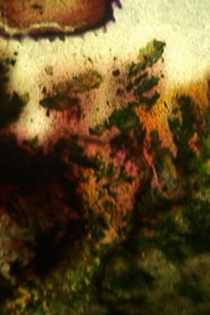
"Jours en fleurs" is a reclamation of flower-power in which images of trees in springtime bloom are subjected to the floriferous ravages of menarcheal substance in a gestation of decay. The title is based on an expression from my coming-of-age in Acadian French Canada where girls would refer to having their menstrual periods as “être dans ses fleurs”. As a result of incubation in menstrual blood for several months, the original images inscribed on the emulsion undergo violent alterations. The shedding of the unfertilized womb depredates the fertilized blossoms and substitutes its own dark beauty.
Jours en fleurs
Just Words
Louise Bourque
Patricia MacGeachy
"Using as it's text Samuel Beckett's 'Not I,' this shocking gift incorporates optically printed home movie footage and an eerily slick close-up of actress Patricia MacGeachy as she rants at lightening speed Beckett's words about home, family and the confines and alienation associated with being a woman." - Program notes, Madcat Film Festival, San Francisco, 2001
Just Words
Jolicoeur Touriste
Louise Bourque
An enclosed space, a struggle against the constraints of personal isolation explored through a fractured narrative. A man living in a broken-down rented room in a Tourist Inn travels through his inebriation, his memories and his fantasies, transcending the limits of time and space, which suddenly intertwine. A film about loss and absence.
Jolicoeur Touriste
Fissures
Louise Bourque
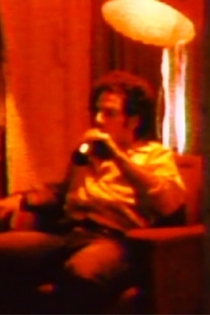
In making this piece, Bourque literally distorted the personal home movie images appearing on the film plane through various manipulations in the process of doing her own low-tech contact printing. The point of contact in printing is continuously shifted so that the film plane appears warped and the images fluctuate, creating a distorted space of fleeting apparitions, like resurfacing memories.
Fissures
Auto Portrait / Self Portrait Post Partum
Louise Bourque
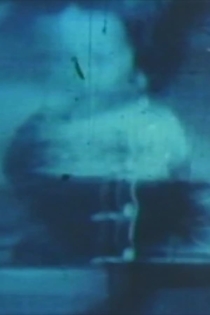
SPPP is an autobiographical experimental film exploring the ramifications of the devastating breakup of a romantic relationship. The film examines my own emotional responses in the context of how this experience is culturally represented. Painstakingly handmade, the visual and sound treatments evoke different phases of the relationship (from passionate attachment to escalating conflict to inexplicable breakup) and the various phases of the grieving process - from denial, to yearning, to anger, to final liberation: a healing release effected through the making of this film. A triptych of self-portraits-entire camera rolls, each subjected to different methods of extreme interventions on the celluloid itself-are presented in a series of tableaux punctuated by quotes reflecting on romantic love scratched into the filmstrip.
Auto Portrait / Self Portrait Post Partum
Self Portrait Post Mortem
Louise Bourque
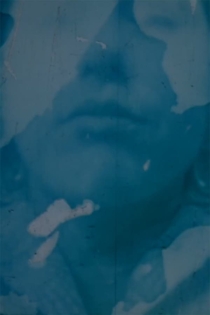
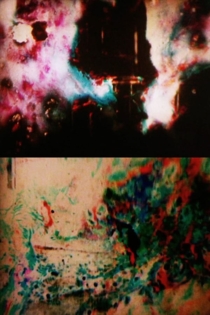
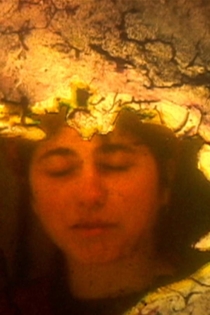
An unearthed time capsule consisting of footage of the maker's youthful self – an “exquisite corpse” with nature as collaborator. Bourque buried random out-takes from her first three films (all staged productions dealing with her family) in the backyard of her ancestral home (adjoining the grounds of a former cemetery) with the ambivalent intentions of both safe-keeping and unloading them (she was relocating). Upon examining the footage five years later she found that the material contained images of herself captured during the making of her first film. That discovery seemed handed over like a gift and prompted the making of this film, a metaphysical pas-de-deux in which decay undermines the image and in the process engenders a transmutation.
Self Portrait Post Mortem
Imprint
Louise Bourque
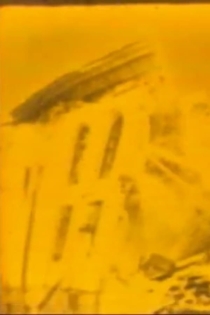
"Louise Bourque's 'Imprint' focuses obsessively on home-movie images of her family's house, which seems gloomily oppressive, almost filling the frame; she repeats the images with various alterations - tinted, bleached, partly scraped away - as if attacking the place, turning its darkness into light." - Fred Camper, The Reader, Chicago, April 16 1999
Imprint
Remains
Louise Bourque
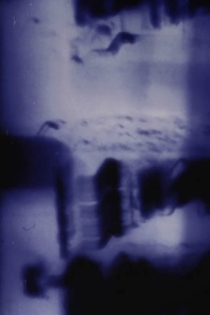
The mother figure revisited is a recurring theme in Louise Bourque’s work. A celluloid deterioration that addresses the ephemeral quality of the captured moment (the present) while revealing the insistent power of human presence in even the most deteriorated of states. The image of the mother is like a ghost that we won't let go. A lament for the inevitable loss of legibility.
Remains
A Little Prayer (H-E-L-P)
Louise Bourque
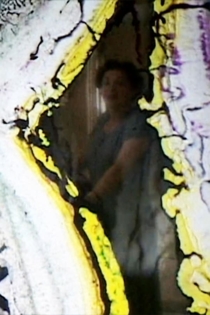
The images of Houdini chained and attempting to free himself: the stop-and-start (interruption-repetition) of his actions; the high-contrast of the images; the stroboscopic effect created by the rhythm of the shutter; the gashes in the emulsion from the hand-processing - combined with the layers of sound, all evoke the violence of a tortured soul in search of escape.
A Little Prayer (H-E-L-P)
The People in the House
Louise Bourque
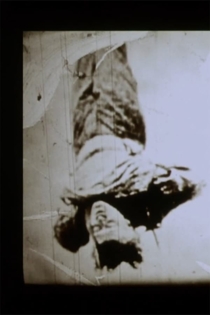
"'The People in the House' examines the dynamics of a family in crisis and questions the role of religious devotion in the perpetuation of dysfunction. The exterior of the house is never seen, and the family's anxiety, as is often the case, plays out within the confines of four walls. Filmed with a dreamy, surreal quality, 'The People in the House' dwells within the tension between harmony and chaos." - Liz Czach, Toronto Film Festival Catalogue, Canada, 1995
The People in the House