
Ryoji Ikeda
1966 (60 лет)三つの光
Kôki Yoshida
Ryoji Ikeda, Hiroshi Suzuki
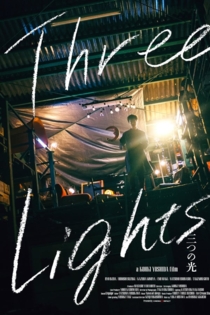
Aoi is a young nursery school teacher whose fiancé leaves her. Her friend Michiko works in a call centre and has ‘lots of free time, but little freedom’. She no longer interacts with her husband, aside from the occasional sad blow job. Then there’s her attractive tennis teacher Masaki, with whom she’s having an affair that’s conducted when they’re pulled up in parking lots. And finally there’s his friend K., a self-proclaimed genius with authoritarian tendencies.
Three Lights
superposition
Ryoji Ikeda
Amélie Grould, Stéphane Garin
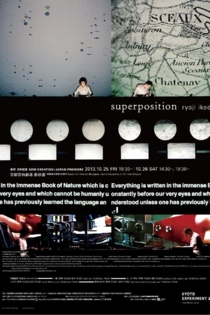
superposition is a project about the way we understand the reality of nature on an atomic scale and is inspired by the mathematical notions of quantum mechanics. Performers will appear in Ikeda’s work for the first time, performing as operator/conductor/observer/examiners. All the components on stage will be in a state of superposition; sound, visuals, physical phenomena, mathematical concepts, human behaviour and randomness – these will be constantly orchestrated and de-orchestrated simultaneously in a single performance piece.
superposition
formula
Ryoji Ikeda
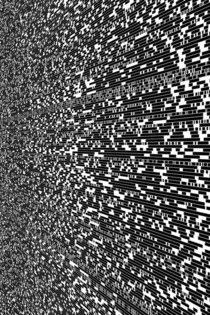
formula, a constantly evolving work updated with each presentation, is a perfect synchronisation between sound frequencies and the movements on the screen. It places the viewer in a binary geometry of space and exploits the darkness to amplify one's perceptions. There is a complete integration of the various elements, composing music, images, lighting and orchestrating the relationships between them through a highly precise score.
formula

code-verse
Ryoji Ikeda
Using musical pitch as a medium, Ryoji Ikeda translates various kinds of data into an almost abstract code—a perfect sequence of “phrases” that create audiovisual compositions like those in code-verse. A universe of code and a code poem, the installation transforms mathematical code into an independent symphonic or polyphonic work. code-verse has no narrative: it communicates with the viewer’s senses. Immersed in white noise, viewers are invited to contemplate the poetry of mathematical relationships and variations in code in the same way one listens to music.
code-verse
data-verse 3
Ryoji Ikeda
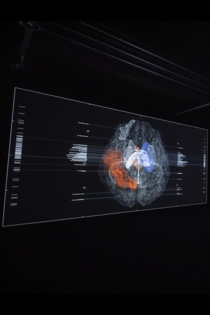
data-verse is a data-driven audio-visual trilogy by artist and composer Ryoji Ikeda which marks a two-decade culmination in the artist’s research. The trilogy addresses the layered dimensions of our world, from the microscopic, to the human, to the macroscopic. Through Ikeda’s process, massive scientific data sets have been transcribed, converted, transformed, de/re/meta-constructed and orchestrated to visualise and sonify the different dimensions that co-exist in our world between the visible and the invisible. Each variation immerses visitors in the vast data universe in which we live, capturing hidden facets of nature and the vast scientific knowledge underpinning our existence. This large-scale data-driven trilogy is generated by extremely precise computer programming and features a minimalist electronic soundtrack, harmonised with Hollywood-standard, high-definition, 4K DCI video projections of scientific data onto a large screen.
data-verse 3
data-verse 2
Ryoji Ikeda
data-verse is a data-driven audio-visual trilogy by artist and composer Ryoji Ikeda which marks a two-decade culmination in the artist’s research. The trilogy addresses the layered dimensions of our world, from the microscopic, to the human, to the macroscopic. Through Ikeda’s process, massive scientific data sets have been transcribed, converted, transformed, de/re/meta-constructed and orchestrated to visualise and sonify the different dimensions that co-exist in our world between the visible and the invisible. Each variation immerses visitors in the vast data universe in which we live, capturing hidden facets of nature and the vast scientific knowledge underpinning our existence. This large-scale data-driven trilogy is generated by extremely precise computer programming and features a minimalist electronic soundtrack, harmonised with Hollywood-standard, high-definition, 4K DCI video projections of scientific data onto a large screen.
data-verse 2
data-verse 1
Ryoji Ikeda
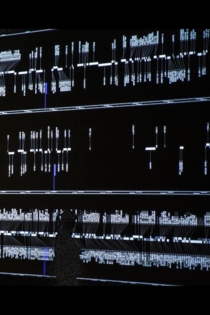
data-verse is a data-driven audio-visual trilogy by artist and composer Ryoji Ikeda which marks a two-decade culmination in the artist’s research. The trilogy addresses the layered dimensions of our world, from the microscopic, to the human, to the macroscopic. Through Ikeda’s process, massive scientific data sets have been transcribed, converted, transformed, de/re/meta-constructed and orchestrated to visualise and sonify the different dimensions that co-exist in our world between the visible and the invisible. Each variation immerses visitors in the vast data universe in which we live, capturing hidden facets of nature and the vast scientific knowledge underpinning our existence. This large-scale data-driven trilogy is generated by extremely precise computer programming and features a minimalist electronic soundtrack, harmonised with Hollywood-standard, high-definition, 4K DCI video projections of scientific data onto a large screen.
data-verse 1
micro | macro
Ryoji Ikeda
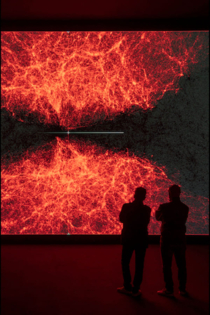
Developed during a residency at CERN, European Organisation for Nuclear Research in Switzerland, micro | macro is an immersive installation which sits at the intersection of art and quantum physics. Ikeda utilises the Planck Scale (which measures the smallest components of the universe – atoms) as a way to contrast our human scale to the microscopic and unobservable. Ikeda tests the limits of what is observable and knowable in our universe in an attempt to understand it, and make it visible to us all.
the planck universe [macro]
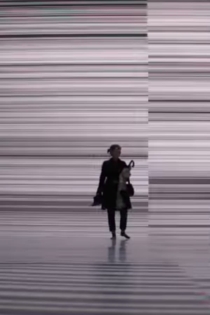
Data.tron [WUXGA]
Ryoji Ikeda
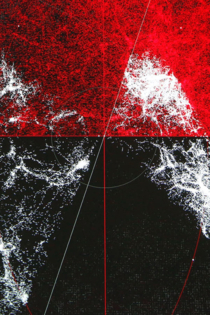
data.tron [WUXGA version] is an audiovisual installation in which every single pixel of a visual image is strictly calculated by a mathematical principle. These images are projected onto an immense screen reflected with a minimal yet intense soundtrack that produces a powerful and hypnotic effect on the visitor. The installation is an alternative entry point into the complexity of data and challenges our assumptions on what kind of visual vocabulary belongs to the world of art versus tech.
Data.tron [WUXGA]
![Data.tron [WUXGA]](https://api.mamonto.com/media/cache/w210_hA/movies/8140/8551/261f3855e14d_6664dcb1eaba8.jpg)