
Nalini Malani
2021Utopia
Nalini Malani
A 16mm black and white film shot after the artist moved to a basic apartment building in a suburb of Bombay, Utopia has also been used in the two-channel installation of the same name, wherein the artist projected this film adjacent to Dream Houses, a 8mm color stop-motion animation that reflects the artist's engagement with the idealism and hope that modernism brought for the Indian middle class and the poor in the Nehruvian sixties. This format allowed her to juxtapose that idealism with the later dystopia of urbanism in the seventies.
Utopia
Hamletmachine
Nalini Malani
Based on the text of Heiner Müller's Hamletmachine, this video play manifests the rise of Hindu fundamentalism in India, which reached a nadir with the frenzied violence of fanatics who destroyed the 16th century Babri Masjid in December of 1992. The growing unrest that followed this destruction provided the extremists with an opportunity to attack and pillage the shanty- towns of the minority Muslim population in a clear case of land grab in Mumbai. Overnight slum colonies were burnt to cinders. The railway stations were filled with Muslims trying to catch any train that might take them away to the safety of their villages.
Hamletmachine
Dream Houses
Nalini Malani
Dream Houses is a 8mm color stop-motion animation that reflects the artist's engagement with the idealism and hope that modernism brought for the Indian middle class and the poor in the Nehruvian sixties. It has also been used in Utopia, Malani's first multiple-screen installation, wherein this film is projected adjacent to the film Utopia, shot after the artist moved to a basic apartment building in a suburb of Bombay. This format allowed her to juxtapose the idealism of the sixties with the later dystopia of urbanism in the seventies.
Dream Houses
Taboo
Nalini Malani
For Taboo, the artist explored the village of Borunda in Rajasthan, where each community occupied their own space, based on caste-ordained professions. Malani chose to film the weavers, where the low-end jobs are done by women, but under no circumstances are they allowed to touch the loom. They are thus excluded from the most important part of the process, where male supremacy rules.
Taboo
Unity in Diversity
Nalini Malani
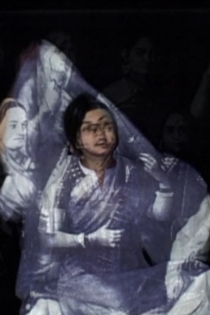
Unity in Diversity is based on the allegorical painting Galaxy of Musicians by the late 19th century Indian painter Raja Ravi Varma. It shows eleven musicians, all women dressed in the different costumes of India signifying unity in diversity. This painting was shown at the World Congress of Religions in Chicago, in 1893, where the philosopher Swami Vivekananda addressed the danger of orthodoxy in religion. A nascent concept of nationalism was emerging at this time with strong reformist movements. The video contrasts this with later histories of the rise of fascism in India and the genocide in Gujarat in 2002 that shook the roots of this democratic country leaving mayhem and despair in its wake. What starts off as a visual fairy tale, where all parts of the nation play in harmony together, ends in a bloodbath.
Unity in Diversity
Onanism
Nalini Malani
The 16mm black and white films Onanism and Still Life were the artist's open revolt against the orthodoxy of the traditional mores that restricted female sexuality in 1960s India. In Onanism, Malani used a crane shot while filming a friend prone to hysteria, lying on the ground suffering a series of physical contortions.
Onanism
Still Life
Nalini Malani
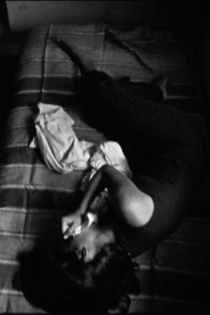
The 16mm black and white films Onanism and Still Life were the artist's open revolt against the orthodoxy of the traditional mores that restricted female sexuality in 1960s India. Her first film, Still Life is a five-minute self-portrait, in which Malani chose not to film herself, but trains the camera on her personal articles of clothing and books as they are dropped on a bed.
Still Life