Yann Beauvais
1953 (73 года)Cinématon
Gérard Courant
Gérard Courant, Alain-Alcide Sudre
Cinématon is a 156-hour long experimental film by French director Gérard Courant. It was the longest film ever released until 2011. Composed over 36 years from 1978 until 2006, it consists of a series of over 2,821 silent vignettes (cinématons), each 3 minutes and 25 seconds long, of various celebrities, artists, journalists and friends of the director, each doing whatever they want for the allotted time. Subjects of the film include directors Barbet Schroeder, Nagisa Oshima, Volker Schlöndorff, Ken Loach, Benjamin Cuq, Youssef Chahine, Wim Wenders, Joseph Losey, Jean-Luc Godard, Samuel Fuller and Terry Gilliam, chess grandmaster Joël Lautier, and actors Roberto Benigni, Stéphane Audran, Julie Delpy and Lesley Chatterley. Gilliam is featured eating a 100-franc note, while Fuller smokes a cigar. Courant's favourite subject was a 7-month-old baby. The film was screened in its then-entirety in Avignon in November 2009 and was screened in Redondo Beach, CA on April 9, 2010.
Cinématon

Temps de mètre
Yann Beauvais
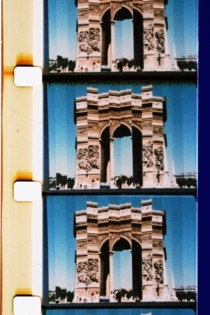
Either the meter: unit of measure. Either the frame: space time unit within the film strip. Either 24fps: speed unit of the apparatus. Either the screen: canvas without retina, the meter at it’s square. Either the projection: the meter taken to its cube. The sum total of these units produces its meaning. Abstract value or short essay on communication, the meter dictates, tires us by its arrogance, its relentlessness. The tacit agreement is what is at stake in this film whose screening at the limit is superfluous. In this sense it also questions the measure of the maitre.
Temps de mètre
29 10 88
Yann Beauvais
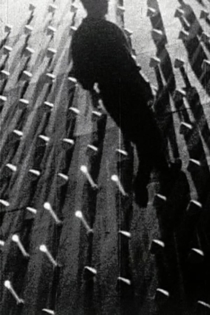
This film places side by side the mirrored image of an installation/performance, by the artist Miles McKane. Rather than documenting the piece, the film tries to restitute the spatial dimensions which occurred in the original piece. The participants movements and the panoramic metaphorically reproduce the base element of the installation, namely the white cone.
29 10 88
Still Life
Yann Beauvais
This film considers the subject of HIV and AIDS from a variety of different viewpoints. On the one hand using textual material in both English and French which appears on screen at different speeds and rhythms, and on the other, articulated by the appearance of human voice on the sound track. It is a story of a person confronted with a civilization which promotes death as a way of life.
Still Life
Work and Progress
Vivian Ostrovsky, Yann Beauvais
A trip to Russia by two filmmakers in 1990, forms the bulk of this twin-screen projection, finished some 9 years later; Their super-8 footage mixed in with archival material (and a sprinkling of the classics such as Vertov and Eisenstein).
Work and Progress