Sari Braithwaite
2021Smut Hounds
Sari Braithwaite
David Stratton
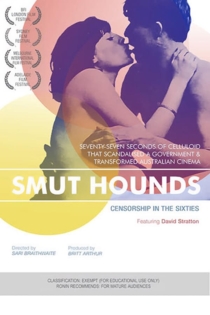
It’s a story that made headlines: “Festival Film Banned!” In the late 1960s, the majority of films screened in Australia were censored in some way or another. DELETE the lovemaking. CUT the ‘Open Mouth Kissing’. REMOVE the fondling of the breast sequence. Deemed too ‘inappropriate’ and ‘morally corrupting’ for Australian eyes, these scenes were hacked from feature films and locked away in government archives. When young Sydney Film Festival director David Stratton attempted to program a Swedish film that the censors believed contained ACTUAL sex, a scandal erupted. In a mash-up of never-before-seen banned clippings, SMUT HOUNDS tells the story of how seventy-seven seconds of celluloid scandalised a government and transformed Australian cinema.
Smut Hounds
[CENSORED]
Sari Braithwaite
Sari Braithwaite
An essay film by filmmaker and archivist Sari Braithwaite, [Censored] offers an overview of film censorship in Australia, told through an ever-changing collage of images compiled from the footage that was cut from films released domestically between 1958 and 1971.
[CENSORED]
![[CENSORED]](https://api.mamonto.com/media/cache/w210_hA/movies/8569/7767/fadd2f4ba1a6_6664e2f33bf89.jpg)
Qiuzhuang
Sari Braithwaite, Katie Mitchell
Li Mu
Li Mu had left the village of Qiuzhuang in his teens to pursue a life of art in the city and then abroad. Twenty-three years later, he returned with a bold, maybe impossible, creative idea: to bring his most beloved modernist artworks by canonical Western artists to his tiny village.
Qiuzhuang
Paper Trails
Sari Braithwaite
Anne Deveson
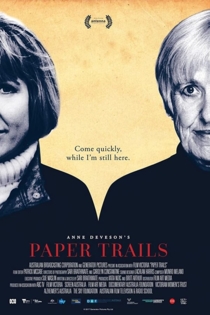
Anne Deveson was a magnificent woman: the first female talk-back broadcaster in Australia, she was also a writer, activist, mental health advocate, and mother. When director Sari Braithwaite met Anne in 2015, she was attempting to bundle up thousands of private papers for the National Library of Australia (NLA). Sari offered to help and over the next six months they transform Anne's 85-year paper trail into a mountain of neatly stacked brown boxes for the permanent collection at the NLA. But during this time, Anne's brain starts to fail her. Alzheimer's, the illness that took her mother and grandmother, is gaining hold, and she is feeling the pressure to move into care. While she has stacks of miscellaneous files to sort, Anne has resolved to keep living in her own home, on her own terms. As she seeks to make sense of her life through the archives, she discovers that the storylines she's seeking to piece together are becoming harder and harder to find.
Paper Trails
You Will See Me
Sari Braithwaite, Conor Bateman
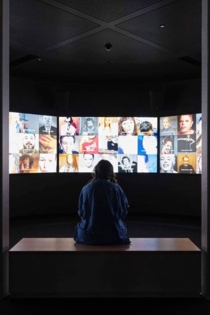
A five-channel video installation commissioned for the permanent exhibition space at the Australian Centre of the Moving Image (ACMI). “The camera doesn’t just capture us, it frames who we are and how we’re seen. Since the camera became more accessible in the mid-20th century, artists and amateurs alike have turned the lens on themselves to create a stage both private and public. This tradition is continued, amplified and transformed through reality TV, the internet and social media, the latest forms to use straight-to-camera techniques to share our common humanity, project authenticity and illuminate how a sense of self can be constructed through the moving image.”
You Will See Me