Jean-Michel Bouhours
1956 (69 лет)Cinématon
Gérard Courant
Gérard Courant, Alain-Alcide Sudre
Cinématon is a 156-hour long experimental film by French director Gérard Courant. It was the longest film ever released until 2011. Composed over 36 years from 1978 until 2006, it consists of a series of over 2,821 silent vignettes (cinématons), each 3 minutes and 25 seconds long, of various celebrities, artists, journalists and friends of the director, each doing whatever they want for the allotted time. Subjects of the film include directors Barbet Schroeder, Nagisa Oshima, Volker Schlöndorff, Ken Loach, Benjamin Cuq, Youssef Chahine, Wim Wenders, Joseph Losey, Jean-Luc Godard, Samuel Fuller and Terry Gilliam, chess grandmaster Joël Lautier, and actors Roberto Benigni, Stéphane Audran, Julie Delpy and Lesley Chatterley. Gilliam is featured eating a 100-franc note, while Fuller smokes a cigar. Courant's favourite subject was a 7-month-old baby. The film was screened in its then-entirety in Avignon in November 2009 and was screened in Redondo Beach, CA on April 9, 2010.
Cinématon
Chantilly
Patrick Delabre, Jean-Michel Bouhours
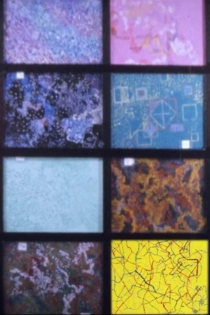
To construct a film in an atomic way, starting from simple elements which combined with each other will produce a whole. Taking the dot as an elementary unit is not a coincidence if we think that the notion of pixels with video images began to occupy people's minds in the 70’s, decades before the arrival of giant led screens. [...] 9, and then 16 screens within one same screen allow an impressive process of simultaneous abstract sequences. The film partition shows a combinatorial process between monochrome colours in the background and pointillist compositions in the foreground. As many sequences as screens; each one is a reflection on abstract images: pointillism, geometrism, "nuagisme" or informal abstraction , are all nods to the history of abstraction in painting: Vassili Kandinsky, Paul Klee, or Augusto Giacometti seem to have been called together within a mondrianesque grid. JMB
Chantilly
Rythmes 76
Jean-Michel Bouhours
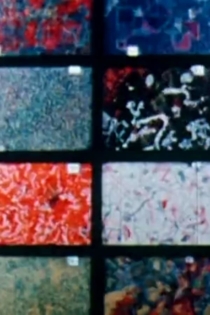
This is my first film based on the unity of the photogram, started in the fall of 1975 and finished at the very beginning of the following year. What to do after Sharits, Kubelka, Kren? How to continue their contribution to cinema? Refusing to accept a cinema where the randomness of images would be the rule, I imagined myself inspired by the musical model. [...] I imagined starting from a fixed photograph that was the vision of my window and building from this image chromatic variations that would select parts of the image. The film was written entirely with the help of a score and was inspired by Steve Reich's repetitive music composition models. [...] - JMB
Rhythms 76
98
Jean-Michel Bouhours
Christian Sacy, Daniel Gottin
It is an attempt to put in representation of my own universe, my "I" being defined through friends filmed in familiar sets. This film precedes the serial movies that will follow. Nevertheless, the repetition is already very present for this film inspired by the music: that of John Cale, emblematic of my own passage from the rock aesthetics (Velvet Underground, Lou Reed, ...) to the minimal American music of La Monte Young, Philip Glass and Steve Reich whose composition processes will orchestrate upcoming films. Filmed with a Pathé Webo DS 8mm camera, the reel was shot several times in the camera in a series of layers of images overprint shot in Paris, Nanterre, La Défense and in the Perche. The filmic matter is apprehended in its thickness; I was very impressed by the film HYNNINGEN by Werner Nekes and Dore O.
98
Film blanc
Jean-Michel Bouhours
The history of modern painting includes white paintings . So why not a "white film"? This film includes images, from the oldest Romanesque cloister in Aragon, dating from the 10th century. These are diaphanous images, devoid of temporality and materiality, bordering on visibility. The repetitive and evanescent character is peculiar to a meditative state, to an illumination. The rhythm is that of the metamorphoses of the shapes of the clouds.
Film blanc
Ombre blanche de l'homme qui marche
Jean-Michel Bouhours
In The Strange Story of Peter Schlemihl written in 1813 by Adelbert von Chamisso, out of necessity of money, the hero decides to sell his shadow to the devil; this shadow is of no use to him; as much as having money. But his life of a being without shade soon becomes unbearable; he is stigmatized as a being apart and is the laughing stock of everyone he crosses. Strange story of a being become strange. So he decides to re buy it back but for that will have to sell his soul to the devil. The shadow (black) is a double that never leaves the Being. The white shadow, negative of the previous one, is obtained by means of a china plate with bas-relief motifs and lit by the back. The expression "White Shadow" thanks to its poetic power became the title of a film by Flaherty, then the name of a bookstore, which was so flourishing that by consulting google today I could not find the origin of the word.
Ombre blanche de l'homme qui marche
Lux Luz
Jean-Michel Bouhours
Autonomous part of the film UNDER THE SIGN OF THE LION, corresponding to the letter L. Camera obscura experience. Capture the light ray, place it in a frame, which itself has a second internal frame. Visual effects of flickers and "counterflickers," as in music we speak of on- and off-beats.
Lux Luz
Sous le signe du lion
Jean-Michel Bouhours
It was while proceeding with the digital restoration of the film CHANTILLY produced in 1976 that the idea for this project came about. Originally the idea was to do a follow-up to the original film, a sort of unrolling of all the graphic elements of the "multi-screen" grid; but very quickly, another film came to the fore. The superimposition of 80 painted transparent celluloid gels and monochromes used for the backgrounds called for new elements to come from a different personal, contemporary reality.
Sous le signe du lion
Jaleo
Jean-Michel Bouhours
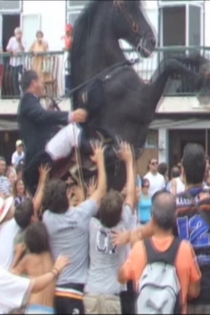
The Jaleo is a summer festival on the island of Menorca (Spain) based on a parade of horses native to the island and exemplary docility, ridden by funny riders, dressed as clergymen or academicians wearing bicorns. The party lasts 24 hours without interruption. The most reckless among the public, often under the influence of alcohol, must raise the animal and move it forward on its two hind legs as long as possible. The musical motif is constantly repeated and becomes a haunting, obsessive tune. The images were captured with what I had on hand: a mobile phone that forced me to record very short sequences. The montage highlights the power of enchantment by repeating situations, gestures and musical motifs. JMB
Jaleo
Chantilly Revisited
Jean-Michel Bouhours
Chantilly Revisited combines the slow-motion images of the film Chantilly (1976) and the original painted elements. It is a work of deconstruction of the grid of the original film which confronts the cinematographic framework as a unit with multiple subdivisions. Does the image framework remain an unsurpassable convention, inherent in the very principle of the traditional image? A reflection on abstraction in cinema.
Chantilly Revisited
Vagues à Collioure
Jean-Michel Bouhours
In the summer of 1914, Collioure was a small, quiet fishing village, sheltered from the convulsions of a blazing Europe. Matisse painted a curious picture Door-Window in Collioure. Homage to Collioure, nod to the cubists, reference to Matisse; offering to the wind and to the sea. The furious Tramontana sends you in spasms its rumblings in the air which has become crystalline. The sea rages under the effect of the wind, which suddenly desert the various small boats; SOS for the unwary. Large breaking waves delight children on the beach.
Vagues à Collioure