Edward Luyken
2021White Line Fever
Edward Luyken
A filmed diary that documents the period that Luyken stayed in the United States. The film consists of three parts: a half-hour filmed in New York, a half-hour report of hitchhiking from the east to the west coast, and again another half hour in New York. The images are edited in a quick sequence; in some cases, the shots are only one frame in length. The name White Line Fever refers to the monotonous succession of white markings on the motorway.
White Line Fever
Seven-Zero-Seven
Edward Luyken
Thérèse Breuls
This film is composed of ten films, some of which originally intended for display on three screens at once; the first was Berlino-Milan-Lisboa ; a film about Berlin in the middle of Milan right and left of Lisbon; with three audio tracks, front, and two each coming from a back corner. The other three-screen films had different lengths, one called Autobiography , with pictures of the creator and his parents, and another called Pieds rouges . The film also includes footage recorded in Bath, England, where Luyken once had a studio.
Seven-Zero-Seven
Ten Past Six
Edward Luyken
Edward Luyken
The visual artist Luyken in his studio (in New York), in a stop-motion film in which he creates ephemeral works of art on a white wall, using paint, wood, string, and similar items. The image is always framed in the same way, and the soundtrack is looped.
Ten Past Six
Entr'acte
Edward Luyken
Edward Luyken, Radboud Molijn
Against the background of a white wall, Luyken films two performances. The images are interspersed with one another: a man and a woman are painted with white paint, while another couple is wrapped in paper and coloured with paint. The second part of the film also consists of a performance. This time, Luyken works with life-sized, cartoon-like fantasy figures. Eventually they are numbered and wrapped in white paper.
Entr'acte
Echelon
Edward Luyken
Echelon begins with images of Luyken’s sons, who are hitting pieces of a sarcophagus. We then see images of performances that depict a disabled woman, followed by shots of wrecked trains. In contrast to these images of destruction are images from the daily life of the artist and his art. The film ends with the demolition of a church building.
Echelon
La rencontre
Edward Luyken
Edward Luyken
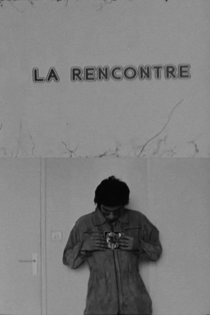
Performance by Edward Luyken in his Paris home. Luyken wears overalls like those worn by German tank soldiers. First he plays with a kind of amulet, then he makes small objects by stacking and sliding together clumps of various sizes. This activity is intermittently interrupted when Luyken has to rewind the spring of his camera every twenty seconds.
La rencontre
Negative
Edward Luyken
Paul Koek, Ron Theunissen
The film begins with negative images of the destruction or etching plates. In the following scenes, we see images of construction workers, (dance) performances, and the daily life of Luyken. Along the way we see positive colored images that include a performance by Paul Koek in the Amsterdam theater Felix Meritis.
Negative
Armature
Edward Luyken
Eva van Heyningen
Luyken reads aloud autobiographical texts, as we see images of a performance by Eve Heyningen as Ophelia. Around the lake are sixteen stones that represent sixteen people. We also see Luyken’s sons canoeing and skiing. The black and white images have been coloured by hand. Stones and canoes are recurring elements in Luyken’s life and films.
Armature
Zero One
Edward Luyken
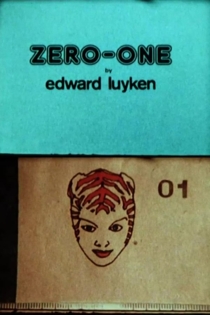
Zero-One is a figurative animation film consisting of thirty short animations. Luyken consistently begins with a triangle. From this triangle, new forms arise that eventually revert back into a triangle. This is a primitive version of morphing, a technique derived from the computer world: it is the gradual fading of one image into another image. In the animation, this technique was already known; an example of an animated film in which the images flow into one another is Pas a deux by Gerrit van Dijk and Monique Renault. The drawings were made on a roll of numbered entrance tickets that were used at the Cinémathèque cinema in Paris. The numbers run from 99 to 0, but not all of the numbers are used in the animation.
Zero One
De macht der twee
Edward Luyken
Eva van Heyningen, George Gajek
Duality is the starting point for this collection of Luyken-like associations: his two sons at different locations perform small actions; signed a cross returns as three-dimensional shape; indoor and outdoor spaces. The soundtrack features the sounds of drumming on metal. The title lapels to Luyken's two sons.
De macht der twee