Byron Grush
2021Phosphene
Byron Grush
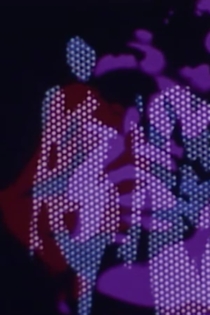
Phosphene features colorful negatives of erotic imagery. Scenes in the film display flashes of sexual intercourse and vibrant inkblots (similar to those seen in Inkaboos). During the creation of this film, Byron was fascinated with the degenerated images in old film footage. He went on to obtain pornographic films shot in 8mm. He photographed individual frames using a still camera with high magnification and further exaggerated the grain and the contrast. Prints of these frames were re-photographed on kodalith negatives and then fastened like animation cels. Colored gels were placed beneath the kodaliths on a light box and the sequences re-animated. The film was screened at the 9th Ann Arbor Film Festival in 1971; however, it was nearly rejected due to its erotic imagery. The music in this film is from the Grateful Dead song, “Viola Lee Blues”, and can also be heard in Fotogrammar. -Chicago Film Archives
Phosphene
Hesper and Phosphor Part 2
Byron Grush
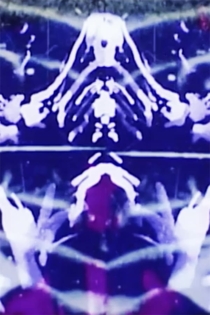
Hesper and Phosphor Part 2 features a variety of images superimposed on one another. Scenes that consistently appear throughout the film include: a woman in curlers, a man getting a haircut, a woman hand painting a small glass bottle, and a man carving a pumpkin.
Hesper and Phosphor Part 2
Fotogrammar
Byron Grush
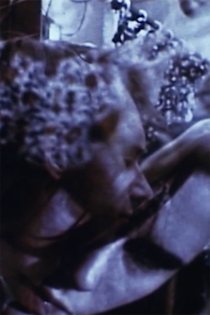
Fotogrammar, like Inkaboos, was created during a period where Grush collected images and experimented with abstractions. By placing very small objects directly onto raw film stock (watch springs, metal shavings, etc.) and exposing the film to light, Grush created Fotogrammar. Sequences were hand-tinted with dyes and in some cases printed symmetrically. The film scenes vary from colorful lines to colorful mechanical pieces, and many shapes in between. Fotogrammar was shown at the 8th Ann Arbor film Festival in 1970. The music in this film is from the Grateful Dead song, “Viola Lee Blues”, and can also be heard in Phosphene.
Fotogrammar
Festival of Cyclists
Byron Grush
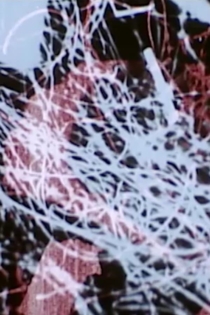
This film appears to focus on the female body in an artistic and colorful manner through the use of superimposition and flashes of repeated scenes. The film begins with two females in the nude, chatting, smoking, and eating saltines. Other scenes include two females in the nude and in a variety of positions: slouching, standing, sitting, etc. They are displayed in many colors and patterns, purple in one scene and polka dots the next. At one point, the women appear to be colorful cutouts moving jaggedly around the screen. In this film and in Hexagrams, Byron re-uses some of the same film scenes to create original content. Festival of Cyclists was created using a film technique invented with a Bell and Howell Film 16mm camera. In this technique, a short loop of film is repeatedly printed onto the camera roll. Byron wrote and published an article in Filmmaker's Newsletter about the technique. In 1972, Festival of Cyclists was shown at the 10th Ann Arbor Film Festival.
Festival of Cyclists
Hexagrams
Byron Grush
Hexagrams is a film of surrealistic nature. In the film, all types of images flash quickly on screen. Images include fried eggs, Marlboro cigarette packages, and the American flag. The film continues flashing images in a quick, rhythmic pace and only slows down at three points in the film. The first slow sequence, is in a junkyard where an automobile is being set down by a tow truck. The second sequence is of two females in the nude, chatting, smoking, and eating saltines. The final slow sequence is of a man who appears to stick his tongue out, but as his "tongue" is pulled out further, it becomes apparent it's some sort of pink substance—not his tongue. In this film and in Festival of the Cyclists, Byron re-uses some of the same film scenes to create original content.
Hexagrams
To Joy
Byron Grush
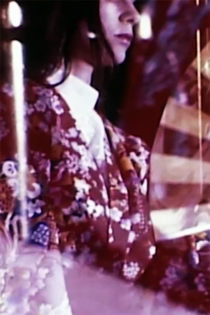
To Joy, completed in 1992, is an imagist film collage set to Beethoven’s Ninth Symphony. According to Byron, this is his second “musical.” The first of these “musicals” was Les Preludes. Opening scenes in To Joy interchange from gardens of yellow flowers to a revolving carousel to a woman in Asian-inspired attire that is spinning an umbrella. Other scenes include a woman belly dancing, as well as young girls dancing ballet and participating in a maypole dance. At one of the To Joy film screenings, Byron was asked who “Joy” is. -Chicago Film Archives
To Joy
Les Preludes
Byron Grush
An imagist “musical” set to Liszt’s Les Preludes that incorporates manipulated color, multiple exposures, and seemingly unrelated images, with references to Les Chants de Maldoror, an early Surrealist novel by Comte de Lautrémont, and the Flash Gordon serials
Les Preludes
Flesh Colored Crayons
Byron Grush
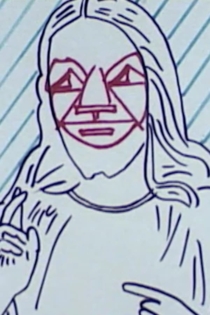
Flesh Colored Crayons was completed in 1992. This film includes an array of animated scenes and sporadic phrases flashing on screen. The scenes are all quite different, beginning with dogs, ducks and people in a park, and continuing with a cowboy placing a revolver in his mouth. One of the longer animated scenes includes an outline of what appears to be Jesus Christ filled in with drawings of a rocket ship, a bull’s eye, Albert Einstein, and more. Some of the phrases that flash throughout the film include: “jogging my memory”, “the year was 1953,” “abort”, and “you can’t dance naked in Indiana”.
Flesh Colored Crayons
Circles
Byron Grush
Martha Glennon, Donald Flood
This film is about circles. The first circular object on screen is a roll of film, the following is an orange, and thereafter, Byron’s film is a journey through all things circular. At one point, the camera itself is spun in circles, which presents a unique camera angle for the viewer.
Circles
Push You Pull Me
Byron Grush
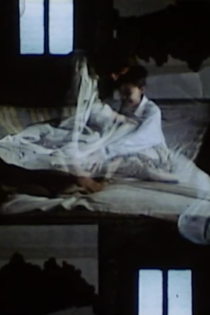
Created by shooting static live action scenes in overlapping exposures, rapidly fading in and out, using the variable shutter on his camera. Instead of rewinding, he simply reloaded the roll and continued double exposing. The scenes include a mix of individuals and settings. As an example, in one scene there are two women chatting. Double exposed on that scene is a news broadcast on a television screen. Exposed again on that scene is a woman cleaning her bed, and so forth. There are up to 12 layers of overlapping images at any given time. The sound track for this film was made by Byron’s sister, Mary Grush. She used a technique called “piano string music” in which the piano is played like a harp and an attached microphone distorts the sounds, producing an almost electronic effect.
Push You Pull Me