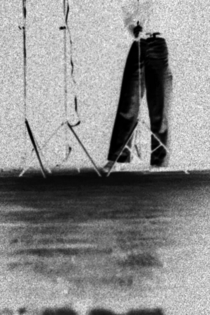
David Haxton
2021In 1976 Haxton bought an 8×10 camera and started photographing the leftover sets from his films. The photographs are like the films, in that they take place in the studio. Haxton states that “The photographed set started in darkness and everything in the photograph was put there including light”. In the Art of Photography he states that, “the photographed set contains the residue of human activity, not unlike the drips in a Pollack painting”. David Haxton says that in general his photographs owe more to Man Ray than Cartier Bresson.
He has a BA degree in Art from the University of South Florida (1961-1965). He also has an MFA degree in painting from the University of Michigan (1965-67).
Haxton’s photographic works were first shown in a Solo exhibition at Sonnabend Paris, 1978. In the 1980’s the photographic works were shown at Sonnabend New York, The Whitney Biennial, and at venues in the US and Europe.
His most recent Solo exhibition was in April of 2019 at Fridman Gallery in New York. The exhibition titled -/+ included films and photographs. In February of 2018 Haxton presented an evening of films at the Centre Pompidou in Paris. In May of 2018 the Centre Pompidou opened Kanal Pompidou in Brussels. An exhibition within the museum titled “The Site of Film” included sixteen of Haxton’s films. His film “Cube and Room Drawings” was included in “America is Hard to See”, the inaugural exhibition at the new Whitney Museum in 2015. Gavlak Gallery in Los Angles mounted a solo exhibition of his films and photographs in April of 2015. In 2012 his film “Painting Room Lights” was included in an exhibition titled “Watch This! New Directions in the Art of the Moving Image” at the Smithsonian American Art Museum. In 1978 the Whitney presented a two-person exhibition of photographs by Jan Groover and David Haxton. In 1978 he was featured in MoMA’s Cineprobe series.
Black on White Tape
David Haxton
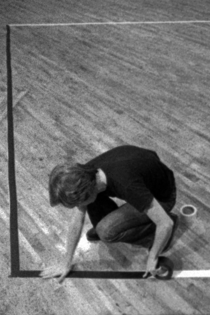
Black on White Tape begins with the camera pointing down at the floor where a roll of white tape is laid on top of a roll of black tape. Haxton enters the frame, picks up the white tape,and beginning at the lower left of the frame, tapes a line up along the left frame. He draws a line on the right,and then horizontal lines at the bottom and top, making a trapezoid. The re-iteration of horizontal and vertical frame lines inside the picture emphasizes the flatness of the projected image against the three-dimensionality of the experience of the room interior. There appears to be perceptual distortion: the top horizontal is wider than the bottom one, destroying the conventional perspective of spatial representation and reinforcing the flatness of the frame. This equivocation between flatness and spatiality is intensified by a cut to negative.
Black on White Tape
Cubes
David Haxton
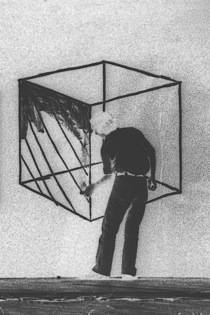
A performer enters carrying a bucket of what appears to be black paint (the film is in negative). He begins to paint lines on what seems to be a white wall. The lines become a 2D representation of a cube. The next image is a "wall" of paper. It is cut away from behind and another cube is gradually revealed in the background. The performer leaves the scene to the side. He re-enters the scene from the left, in the foreground. He then destroys parts of the foreground cube by cutting it away. This reveals the fact that the cube is not flat but suspended in space. He again leaves the scene from the left only to re-appear in the rear of the scene. He then draws in the lines of the foreground cube at the rear of the space. He then returns to the foreground and completes the cutting away of the foreground cube. Upon completion of this he returns to the rear and fills in the foreground lines. The film ends after he fills in one side of each cube with solid black
Cubes
Painting Room Lights
David Haxton
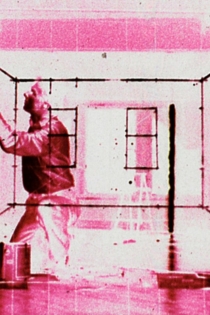
In Painting Room Lights a performer paints four fluorescent lamps and makes a drawing of a landscape with a rectangular solid in the foreground. He also makes a drawing of a room in one point perspective. Two four foot fluorescent lamps stand in the foreground and two eight foot fluorescent lamps stand in the background. The drawing of the landscape and the drawing of the room appear to be made on a white surface (the film is in negative and the lights are turned off in the room). A deep space is revealed behind the drawings when the fluorescent lamps are turned on in the background. The performer then paints the fluorescent bulbs. As the lamps are painted the room disappears and the drawing seems to be again on the flat surface. The drawings are cut with scissors and they fall out of the film frame. The process is repeated with the lights in the foreground. The film is in color and the fluorescent lights are green. The negative film effectively casts the scene in red.
Painting Room Lights
Cube and Room Drawings
David Haxton
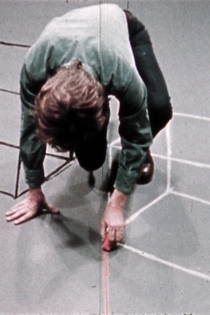
Cube and Room Drawings begins with a view looking down at an angle toward grey paper covering the floor. A performer enters from the back of the scene and begins drawing lines on the floor. The lines are the beginning of a drawing of a distorted cube. The performer leaves the scene. The paper begins to rotate on the floor. As the paper rotates the cube gradually becomes correctly oriented, as if it were drawn on a vertical piece of paper. The performer enters again and draws another cube that corresponds to the perspective of the other cube. After leaving and re-entering the performer draws red receding lines on the floor. He leaves and the paper rotates and the red lines become a grid that corresponds to the vertical screen. The film continues with several additional actions that continue this theme.
Cube and Room Drawings
Cylinder Sphere and Solid
David Haxton
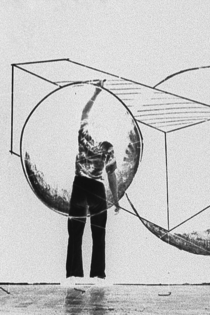
Cylinder, Sphere and Solid opens with a white screen. A performer enters from the right side and draws a black circle. He continues to draw and finally, after drawing and erasing, the circle becomes a cylinder. While continuing to draw and erase the cylinder becomes two intersecting circles. After drawing some more the drawing becomes two spheres.
Cylinder Sphere and Solid
White Red and Green Lights
David Haxton
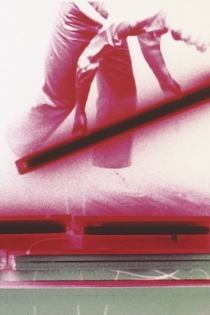
"White, Red and Green Lights" opens with a blank white screen. A performer enters, and the viewer realizes that the camera is placed above the scene looking back in space toward the floor. The performer brings in fluorescent light tubes and places them on the floor horizontally near the bottom of the screen. This positioning corresponds to the foreground in the filmed scene The lights appear to be black since white is black in negative. The film switches to color negative and the performer brings in both red and green fluorescent tubes. These are also placed near the bottom of the screen. Finally he moves the red and green lights to the side edges of the screen and the film ends with red and green lights running up the sides of the screen.
White Red and Green Lights
Drawing Houses
David Haxton
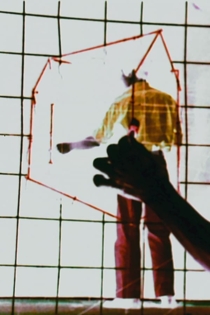
Drawing Houses consists of two parts. In each part performers make drawings of houses. The first part is filmed at a high angle looking down at a floor. The scene opens with a close-up of the back of a Hawaii-an shirt. The Hawaiian shirt wearer moves out and a performer enters and begins to draw on the floor. A drawing of a house is made on the floor. The drawing is made so that it appears to be on the plane of the projected image and not on the receding floor plane. In the second part of the film the camera is placed so that the scene is viewed straight on. This scene opens with a black line grid on the screen. A large facial profile appears when the perfomer removes some paper that covers it. He draws in the facial details. The performer then draws a line drawing of a house. This drawing looks similiar to the one from the earlier scene. Another house is drawn in the background. However parts of each house are drawn on different planes.
Drawing Houses
Cutting Light and Dark Holes
David Haxton
Cutting Light and Dark Holes, like Overlapping Planes, works with the flatness of the film plane against the spatial depth of a situation. The film, entirely in negative image, begins with a black sheet of paper filling the frame. Haxton enters from the left and cuts four rectangles in the paper, two on the left and two on the right, leaving four white rectangles. He then removes the black sheet by rolling it off from left to right, revealing four black rectangles underneath, cut out of a sheet of white paper. He rolls this paper from left to right,leaving the frame black again. The surface looks identical to the black frame at the beginning of the film: as in Overlapping Planes, there is no way of differentiating between the appearances of flatness without signs of activity within the space.
Cutting Light and Dark Holes
Painting Lights
David Haxton
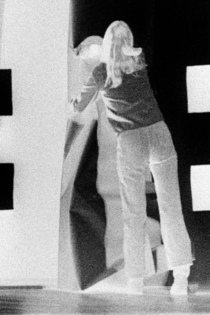
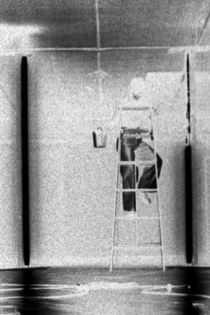
Painting Lights is about a light source in reverse: how, with negative film, light becomes a source of blackness instead of illumination -how the absence of light creates a light (or white) frame, and flattens out a three-dimensional room space to a two dimensional image in which there are only flat lines on the screen. The film begins with a woman in deep space, on a ladder, painting a vertical tube-light on one side of the screen with "White" paint. As she works, there is less and less light-the dark reflections of light on the floor disappear and the frame becomes whiter. She paints a second light, continuing to white out the frame, and then she dis-appears, leaving nothing except a few traces of black where the lights have been painted over.
Painting Lights
Landscape and Room
David Haxton
Landscape and Room opens with a rudimentary line drawing of a landscape on a white screen. A performer enters in the foreground and begins making a line drawing of a room over the landscape drawing that is already there. The performer leaves the screen in the foreground and after a few seconds he re-enters. He then proceeds to use scissors to cut away the drawing of the landscape. The drawing of the room is left on the screen. The performer then gradually appears from behind a large piece of paper as he cuts it away. A drawing of a rectangular solid also appears as the paper is cut away. The performer leaves. After cutting away some lines from the rectangular solid the performer cuts away the drawing of the room. He then reappears from behind as he cuts away another layer of paper that covers the scene. As he cuts the paper away another drawing of a rudimentary landscape appears. The solid is now in the landscape. The film ends with the performer filling in the solid with red chalk.
Landscape and Room
Painting in Object
David Haxton
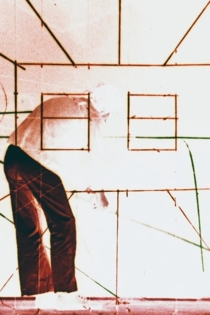
The emergence of a "real" three dimensional object from its two-dimensional appearances is the subject of Painting in Object. The film is in negative and begins with a totally white screen. Haxton enters the frame and paints a large black square about person-height parallel to the frame: at first it looks as if he is painting on a flat piece of paper or on a wall, although it is hard to understand how the painting is perfectly done. He walks through the square to the back and "disappears", the lighting of the square is from the side so that it illuminates only a narrow slice of space. He then comes back into view from behind the square and paints in diagonal lines from the corners, the beginnings of perspective, stilI very flat, as if perspectival illusion. He disappears through the square into whiteness again and turns the square around so that the painted part vanishes, one sees that it is the frame of a wooden cube.
Painting in Object
Vertical and Receding Lines
David Haxton
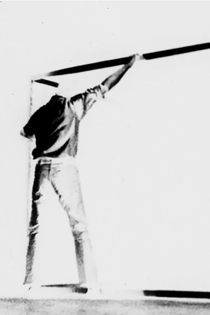
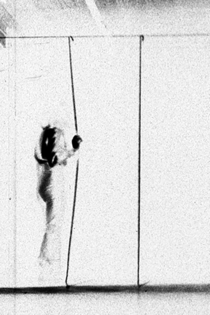
As in Bringing Lights Forward, Haxton makes use of negative images and restricted lighting to emphasize the actual flatness of the film image over the illusion of three-dimensionality that it conveys. Five black strings, hanging from a black rod close to the top of the frame and parallel to it, are spaced at fairly regular intervals. A woman comes into the foreground, picks up the five strings one at a time and pushes them each into the background, her image gradually becoming more indistinct as she does so. At the end of this process, only the tops of the strings attached to the black rod are left visible on screen. The woman then returns, picks up one end of another string and attaches it to the floor; she repeats this movement so that the strings are secured at five different points. The final composition of the frame consists of one set of black lines extending downwards vertically from the top, and another set receding at an angle into the background from the bottom.
Vertical and Receding Lines
Pyramid Drawings
David Haxton
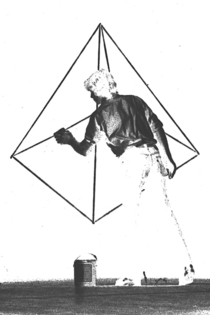
Pyramid Drawings opens with a white screen and a narrow floor area at the bottom. From the left, a performer enters, carrying a bucket of paint. The film is in negative therefore everything light is dark and everything dark is light. The performer begins to draw black lines on what appears to be a white wall. The drawing gradually becomes to be a pyramid seen in perspective. The performer leaves and the drawing is left for contemplation by the viewer. The performer re-enters with a pair of scissors and cuts what appeared to be lines. The lines fall to the floor. The performer then commences to build a new pyramid with new strings stretched back and forth in the space.
Pyramid Drawings
Overlapping Planes
David Haxton
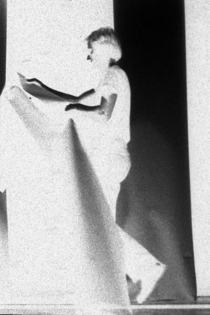
Overlapping Planes, all in negative image, begins with a completely white frame. A dark line appears at the top, proceeding downward: the surface of the paper is being cut from behind by Haxton. Two more incisions are made behind and then two alternate strips of paper are cut off horizontally and removed. Haxton then cuts incisions in a sheet of black paper hanging behind the sheet of white, directly behind the two missing slats. When he removes these, the frame is white again. He then cuts off the two white strips remaining in front, revealing the two posterior strips of black he had left. Finally, he removes these black strips so that the frame is white again. The film works with the relation between the flatness of the projected film and the depth one reads into a known spatial context.
Overlapping Planes
Black and White Drawing
David Haxton
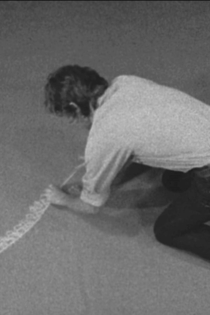
Black and White Drawing is about the two dimensionality of the film frame and the illusion of three dimensionality created by drawing. A sheet of gray paper is placed on the floor front of the camera. The film switches to negative: the paper is now darker, a different shade of gray. Haxton sketches in with "black" chalk black areas in wavy lines and goes over and over them, making them more solid. He leaves the frame. There is a cut to positive image: the chalk draws along the first areas, uniting them into a single shape that looks somewhat like a twig or a tuning fork with one short leg which appears at first to be equal in length to the other. Haxton uses the conventions of shading as "shadow" to make the white areas look like volumetric or perspectival extensions of the black: the drawing seems very object like.
Black and White Drawing
Bringing Lights Forward
David Haxton
Bringing Lights Forward describes the film set through the manipulation of lights on stands. A woman is seen placing three lamp stands at the center, left, and right of the screen and then moving them gradually into the foreground - the surface of the screen- in several distinct stages. As she makes a move she turns the lights on and off. Finally she clusters the three stands at the center of the screen but in such a way that the lamps themselves, the light source for the film, are cut off by the top of the frame yet still illuminating the screen. The woman walks off-screen once she has completed this action. The placement and movement of the lamp stands and the use of negative in this film serve as a literal demonstration of the way in which light affects the perceptual quality of the film image.
Bringing Lights Forward