The Otolith Group
2021Otolith II
The Otolith Group
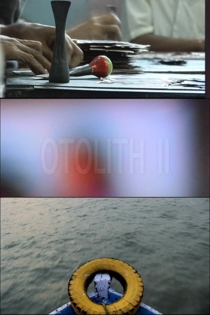
Otolith II mixes fiction, archival material and documentary footage filmed in Mumbai and Chandigarh. It explores the pressures exerted on inhabitants by competing projections of the city of tomorrow. Predictive models of the urban masterplan, corporate scenarios and real estate speculation converge to extract labour, convert attention and capture potential for profit.
Otolith II
Anathema
The Otolith Group
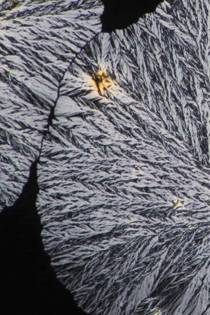
Anathema is a contemporary Fantasia on the notion of the network and its inherent instability, where the organic networks of human relations and the crystalline lattices of silicon-based technologies intertwine, and often tangle. From the artists’ statement: Anathema re-imagines the microscopic behavior of liquid crystals undergoing turbulence as a sentient entity that possesses the fingertips and the eyes enthralled by the LCD touch-screens of communicative capitalism. Anathema can be understood as an object-oriented video that isolates and recombines the magical gestures of dream factory capitalism. By bringing the telecommunicating couplings of mother-father-daughter-son-machines and boyfriend-girlfriend-units into contact with the conductive imagery of liquid crystallization, Anathema proposes itself as a prototype for a counter-spell assembled from the possible worlds of capitalist sorcery.
Anathema
Otolith I
The Otolith Group
Set in the twenty-second century when the human race lives on the International Space Station, Otolith I imagines a mutant future that harks back to the Cold War era. An exo-anthologist is researching life on an earth she can only experience through a media archive.
Otolith I
In the Year of the Quiet Sun
The Otolith Group
The essay film In the Year of the Quiet Sun (2013) takes its name from the decrease in solar surface temperature that occurs every eleven years. From November 1964 to November 1965, the nation states of the world issued postage stamps to commemorate the first scientific expedition to study the sun. As the stamps turned their face towards the sky, they overlooked the unstable land of Africa's newly independent states.
In the Year of the Quiet Sun
The Third Part of the Third Measure
The Otolith Group
Elaine Mitchener, Dante Micheaux
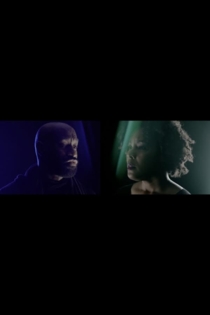
The Third Part of the Third Measure creates an encounter with the militant minimalism of black avant-garde queer composer, pianist and vocalist Julius Eastman. The film focuses on what The Otolith Group describe as ‘an experience of watching in the key of listening’, invoking political feelings of defiance and the collective practice of movement building that participates in the global struggles against neoreactionary authoritarianism. The Third Part of the Third Measure invites viewers to attend to exemplary ecstatic aesthetics of black radicalism that Eastman himself once described as ‘full of honour, integrity and boundless courage’.
The Third Part of the Third Measure
Communists Like Us
The Otolith Group
In the film, images from archives of photographic documentation of encounters between politicians and activists in India with their counterparts in Japan, Mao’s China, and other Asian countries from the mid 1950s to the early ’60s are overlaid with transcribed dialogue from Jean Luc Godard’ s 1967 film La Chinoise, creating a conversation between historical archives, photography, cinema, and art.
Communists Like Us

I See Infinite Distance Between Any Point and Another
The Otolith Group
Etel Adnan
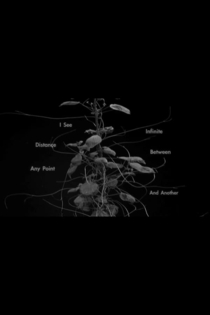
Etel Adnan's highly influential writings, in French, English and Arabic have been read around the world. Her recent epic poem, Sea and Fog, published by Nightboat Books, in 2012, evokes the sea and the fog as metaphors for power and time, exploring the nature of the individual spirit and the sentience of the natural world. The Otolith Group's film, shot largely in Adnan's Paris apartment, centers on a reading of the first chapter of her poem, Sea. The sound of Adnan's gentle voice, and the quiet but ever present ambient noise in her apartment, create a powerful, meditative atmosphere that draw upon the powers of philosophy to pursue the continuous mutation of matter into velocity. If poetry can be understood as a study in constraint, the film, I See Infinite Distance Between Any Point and Another, can be understood as an experiment in concentration and a study of gestures, that speaks of the mobility of language and the movement of the ocean.
I See Infinite Distance Between Any Point and Another
Medium Earth
The Otolith Group
Part prequel and part premonition, Medium Earth attunes itself to the seismic psyche of California. The film listens to its deserts, translates the writing of its stones, and deciphers the calligraphy of its expansion cracks, animating the stresses and strains of physical geography undergoing continental pressure. - IFFR
Medium Earth

INFINITY minus Infinity
The Otolith Group
Elaine Mitchener, Kathryn Yusoff
INFINITY minus Infinity draws on several inspirations: the modernist verse of the Jamaican poet Una Marson, the alluvial invocations of the Martinican philosopher and poet Édouard Glissant, the black feminist poetics of the Brazilian philosopher Denise Ferreira da Silva, and the racial formation of geology theorised by British geographer Kathryn Yusoff amongst others in order to envision a black feminist cosmos animated by the principles of mathematical nihilism.
INFINITY minus Infinity

Otolith III
The Otolith Group
Otolith III proposes an alternate trajectory for the fictional protagonists of The Alien, the unrealised screenplay by legendary Bengali director Satyajit Ray. Written in 1967, The Alien would have been the first science fiction film to be set in contemporary India.
Otolith III
O Horizon
The Otolith Group
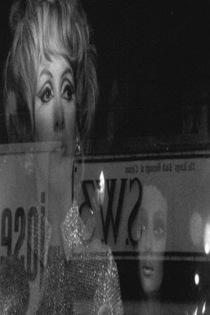
Researched, filmed, and recorded on Visva-Bharati campus at Santiniketan, Sriniketan and surrounding areas of Birbhum, West Bengal, O Horizon stages moments from Rabindranath Tagore’s extensive environmental pedagogy as a series of portraits, moods, studies, and sketches that allude to what might be described as the outlines of a “Tagorean cosmopolitics”.
O Horizon

Message of the Forest. Towards 'O Horizon'
The Otolith Group
Message of the Forest can be heard as an ode to the Sal Forests of West Bengal, or a song for the weathering of parent rocks, or an incantation inspired by Rabindranath Tagore’s vision of a world cam- pus that would become Visva-Bharati in Santineketan in West Bengal in 1921.
Message of the Forest. Towards 'O Horizon'
The Radiant
The Otolith Group
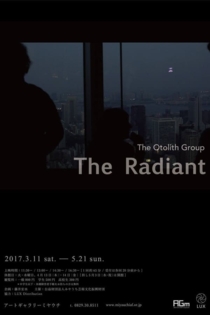
The Radiant explores the aftermath of March 11, 2011, when the Tohoku earthquake triggered a tsunami that killed many thousands and caused the partial meltdown of the Fukushima Daiichi nuclear power plant on the east coast of Japan. Burdened by the difficult task of representing the invisible aftermath of nuclear fallout, The Radiant travels through time and space to invoke the historical promises of nuclear energy and the threats of radiation that converge in Japan in the months immediately following the disaster.
The Radiant