Vladimir Uralsky
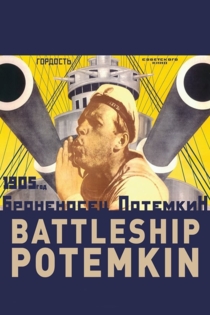
1887 - 1955Броненосец Потёмкин
Sergei Eisenstein
Aleksandr Antonov, Vladimir Barsky
A dramatized account of a great Russian naval mutiny and a resultant public demonstration, showing support, which brought on a police massacre. The film had an incredible impact on the development of cinema and is a masterful example of montage editing.
Battleship Potemkin

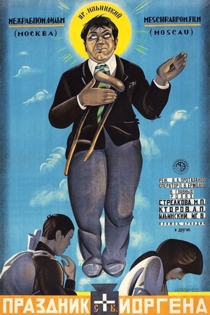
Праздник святого Йоргена
Yakov Protazanov, Porfiri Podobed
Igor Ilyinsky, Anatoli Ktorov
The priests, stock market officials, and police conspire to squeeze income out of pilgrims come to see relics of a Christ like figure. A pair of con men try to pass of a resurrected saint.
St. Jorgen's Day
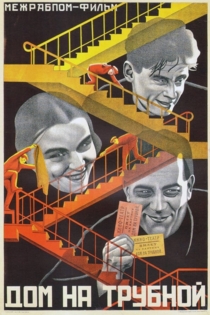
Дом на Трубной
Boris Barnet
Vera Maretskaya, Anel Sudakevich
Life is short and full of oppression, but that doesn't mean Parasha can't find love and laughter when she leaves her country home to take a job as a maid in the overcrowded, overworked, and underpaid world in the big city.
The House on Trubnaya
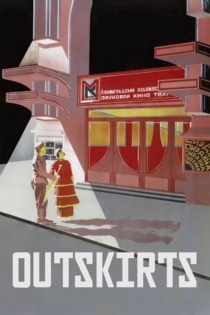
Окраина
Boris Barnet
Aleksandr Chistyakov, Yelena Kuzmina
Outskirts is an internationally renowned masterpiece of early sound cinema. In a remote Russian village during World War I, colorful and nuanced characters experience divided loyalties: family loyalty vs. personal desire, nationalism vs. transcendent humanism.
Outskirts
Ветер
Cheslav Sabinsky, Lev Sheffer
Nikolai Saltykov, Oksana Podlesnaya
During the Civil War following the Bolshevik Revolution, a Red cavalry officer is warned by a staffer from headquarters about his dangerous attraction to the female leader of a band of Cossacks, a violent woman who is aroused by killing.
Veter

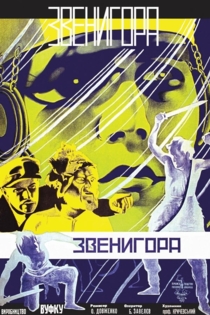
Звенигора
Alexander Dovzhenko
Nikolai Nademsky, Semyon Svashenko
The momentous film stars Mykola Nademskyi as the grandfather of Tymish (Semen Svashenko), whom he alerts to secret treasure buried in the mountains of Zvenygora – Treasure that rightfully belongs to his homeland. The film wonderfully blends both lyricism and politics and uses its central construct to build a montage praising Ukrainian industrialization, attacking the bourgeoisie, celebrating the beauty of the Ukrainian steppe and retelling ancient folklore. Said Sergei Eisenstein of the film, "As the lights went on, we felt that we had just witnessed a memorable event in the development of the cinema".
Zvenygora
Prostoy sluchay
Mikhail Doller, Vsevolod Pudovkin
Aleksandr Baturin, Yevgeniya Rogulina
As a response to criticism for the allegedly excessive “mass appeal” of his earlier epic STORM OVER ASIA (1928), Vsevolod Pudovkin unleashed his flair for experimentation in what was supposed to be the director’s first sound feature. Everything went wrong: technical problems forced him to complete the film as a silent; viewers were baffled by the lack of a recognizable plot; then, the ideological climate of the Soviet Union changed. He was now being blamed for catering to bourgeois taste! Time has come to set the record straight. Here’s lyrical cinema at its best, deliberately operatic and yet intimate as it matches the characters’ inner life with the solemn rhythms of nature, and depicted through breathtaking black-and-white photography. A sensation at last year’s Pordenone fest, Pudovkin’s long-forgotten swan song to the art of montage is resurrected by Gabriel Thibaudeau’s emotionally charged live music performance. –PCU (USSR, 1930, 75m)
A Simple Case
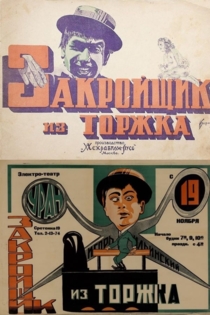
Закройщик из Торжка
Yakov Protazanov
Igor Ilyinsky, Olga Zhiznyeva
A 1925 Soviet comedy sponsored by the Soviet Finance Ministry, with a plot promoting the new economy. A small-town tailor, Petya Petelkin (Ilyinsky), bought a lottery ticket and handed it to his landlord, widow Shirinkina (Deykun) who wants to marry him. Petya is a hard-working tailor trying to start his own business. He is also in love with Katya (Maretskaya), whom he wants to marry. He has to survive a cascade of funny situations in the unstable Soviet reality, before his romance with Katya comes to a happy ending.
The Tailor from Torzhok
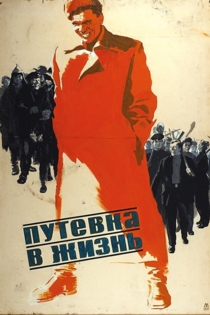
Путёвка в жизнь
Nikolai Ekk
Nikolai Batalov, Yvan Kyrlya
Young hobos are taken to a new camp to become good Soviet citizens. This camp works without any guards, and it works well. But crooks kill one of the young people when they try to damage the newly built railroad to the camp.
Road to Life
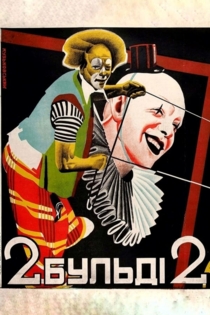
Два-Бульди-два
Nina Agadzhanova, Lev Kuleshov
Sergei Komarov, Vladimir Kochetov
Naturally, the circus milieu of 2 Buldy 2 (1929) encourages stunts. A father and son, both clowns, are to perform together for the first time, but the civil war separates them, and the elder Buldy, tempted for a moment to acquiesce to the White forces, casts his lot with the revolution. At the climax Buldy Jr. escapes the Whites thanks to flashy trampoline and trapeze acrobatics; the gaping enemy soldiers forget to shoot.
Two-Buldi-Two
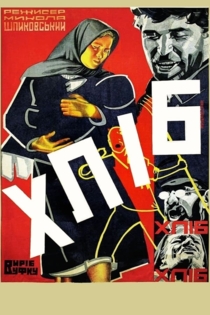
Хліб
Nikolai Shpikovsky
Fedir Hamalii, Dmytro Kapka
Ukrainian agitprop film from 1929 that was banned and long forgotten until its rediscovery in the 1970s, imaginatively shot by the gifted cameraman Oleksii Pankratiev, whose panoramic long shots feature dynamic compositions. The background, barren field and bare sky, raise the agricultural subject matter to the level of an epic poem. Using innovative editing, Shpykovskyi transformed an incredibly simple plot into an avant-garde work. Created the same year as Earth (Zemlya), the film forms a paradoxically conceptual, ideological, and aesthetic pair with Dovzhenko’s movie.
Bread
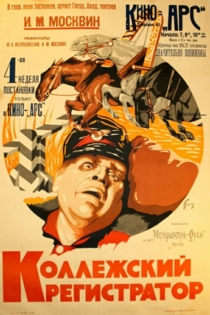
Коллежский регистратор
Yuri Zhelyabuzhsky, Ivan Moskvin
Vsevolod Aksyonov, Nikolai Aleksandrov
A small town postal official allows a military officer to take his lovely daughter away to St. Petersburg, assuming the man will do the right thing and marry her.Instead, a future of scandal and tragedy await her.
The Stationmaster