Friedrich Hollaender
1896 - 1976Friedrich Hollaender (in exile also Frederick Hollander; 18 October 1896 – 18 January 1976) was a German film composer and author.
He was born in London, where his father, operetta composer Victor Hollaender, worked as a musical director at the Barnum & Bailey Circus. Young Hollaender had a solid music and theatre family background: his uncle Gustav was director of the Stern Conservatory in Berlin, his uncle Felix Hollaender was a well-known novelist and drama critic, who later worked with Max Reinhardt at the Deutsches Theater.
In 1899 Hollaender's family returned to Berlin, his father began teaching at the Stern Conservatory, where his son became a student in Engelbert Humperdinck's master class. In the evening he played the piano at silent film performances in local cinemas, developing the art of musical improvisation. By the age of 18 he was employed as a répétiteur at the New German Theatre in Prague and also was put in charge of troop entertainment at the Western Front of World War I.
Having finished his studies, he composed music for productions by Max Reinhardt and became involved in Berlin's Kabarett scene. Together with Kurt Tucholsky, Klabund, Walter Mehring, Mischa Spoliansky and Joachim Ringelnatz he worked in venues like Reinhardt's Schall und Rauch ensemble at the Großes Schauspielhaus or the Wilde Bühne led by Trude Hesterberg at the Theater des Westens in Charlottenburg, where he established the Tingel-Tangel-Theater cabaret in 1931.
In 1919 he married the actress Blandine Ebinger, the couple divorced in 1926. Their daughter Philine later became the wife of the cabarettist Georg Kreisler. Hollaender had his final breakthrough, when he wrote the film score for The Blue Angel (1930), including the most popular song "Falling in Love Again (Can't Help It)", performed by Marlene Dietrich.
He had to leave Nazi Germany in 1933 because of his Jewish descent[1] and first moved to Paris. He emigrated to the United States the next year, where he wrote the music for over a hundred films, including Destry Rides Again (1939), A Foreign Affair (1948), The 5,000 Fingers of Dr. T (1953 Academy Award nomination) and Sabrina (1954). Many of his songs were again made famous by Marlene Dietrich. He can be seen as the piano accompanist in A Foreign Affair (on the songs, "Black Market", "Illusions" and "Ruins of Berlin"). He received four Academy Award nominations for composition. As "Frederick Hollander", he also wrote the semi-autobiographical novel Those Torn From Earth, released in 1941, which details the flight from Germany that many Jewish members of the film industry embarked on after the Nazis came to power and instituted the Nuremberg Laws.
In 1956 he returned to Germany and again worked for several years as a revue composer at the Theater Die Kleine Freiheit in Munich. He made a cameo appearance in Billy Wilder's film comedy One, Two, Three (1960) as a Kapellmeister. Hollaender died 1976 in Munich and is buried in the Obergiesing Ostfriedhof.
One, Two, Three
Billy Wilder
James Cagney, Liselotte Pulver
C.R. MacNamara will do anything to get a promotion within the Coca-Cola company, including looking after boss W.P. Hazeltine's rebellious teenage daughter, Scarlett. When Scarlett visits Berlin, where C.R. is stationed, she reveals that she is married to a communist named Otto Piffl -- and C.R. recognizes that Otto's anti-establishment stance will clash with his boss's own political views, possibly jeopardizing his promotion.
One, Two, Three

Der blaue Engel
Josef von Sternberg
Emil Jannings, Marlene Dietrich
Prim professor Immanuel Rath finds some of his students ogling racy photos of cabaret performer Lola Lola and visits a local club, The Blue Angel, in an attempt to catch them there. Seeing Lola perform, the teacher is filled with lust, eventually resigning his position at the school to marry the young woman. However, his marriage to a coquette -- whose job is to entice men -- proves to be more difficult than Rath imagined.
The Blue Angel


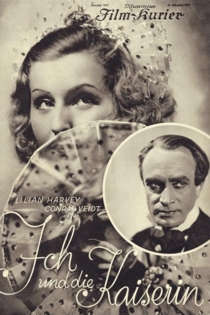
Ich und die Kaiserin
Friedrich Hollaender
Lilian Harvey, Mady Christians
A dashing marquis bends from his horse when he discovers a lost garter in the woods and falls. During his delirium he is serenaded by a little hairdresser. She is the person who lost the garter to begin with and has only come to get it back having borrowed it from her employer--the empress of France. The marquis mistakenly thinks he was nursed by the empress, herself, and decides to woo her.
The Only Girl