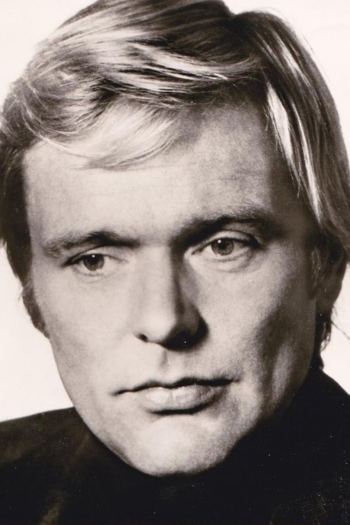
Helmut Griem
1932 - 2004Helmut Griem (born April 6, 1932 in Hamburg – November 19, 2004 in Munich) was a German actor.
Griem was primarily a German-speaking stage actor, appearing at the Thalia Theater in Hamburg, the Deutsches Schauspielhaus in Hamburg, the Burgtheater in Vienna, the Staatliches Schauspielbühnen in Berlin, in the Munich Kammerspiele, and finally in the Staatstheater am Gärtnerplatz, also in Munich.
Among his many film and TV appearances (a quite memorable one being NBC's mini-series Peter the Great, portraying the formidable Tsar's lifelong friend and "right hand" Alexander Menshikov, alongside Maximilian Schell), the Oscar-winning film Cabaret (1972), in which he played the rich "Baron Maximilian von Heune" is probably the best-known; other internationally-known performances include his work in The Damned, The McKenzie Break, and Ludwig. Griem starred in the television mini-series "The Devil's Lieutenant" directed by John Goldschmidt, adapted by Jack Rosenthal and based on the novel by M Fagyas, for Channel 4 and ZDF.
Despite his success in film, the theatre remained at the heart of Griem's work, and he performed in many classic roles from both the German and English-language repertoire. Later in his career Griem turned to theatre direction, including Long Day's Journey Into Night by Eugene O'Neill. Before his death, Griem had planned to direct the Botho Strauss play Die eine and die andere (This One and The Other).
Griem twice won the Bambi Award: in 1961 and in 1976.
Description above from the Wikipedia article Helmut Griem, licensed under CC-BY-SA, full list of contributors on Wikipedia.
Berlin Alexanderplatz
Rainer Werner Fassbinder
Günter Lamprecht, Claus Holm
Франц Биберкопф, бывший грузчик, выходит из берлинской тюрьмы в Тегеле, где он просидел четыре года за убийство своей невесты Иды. Этот крепкий мужчина чувствует себя одиноким и беззащитным, и ему кажется, что «наказание» только начинается…
Berlin Alexanderplatz



Lourdes
Lodovico Gasparini
Alessandro Gassman, Angèle Osinsky
The young, sickly girl Bernadette comes from a poverty-stricken family. When the Virgin Mary appears to her in a cavern near Lourdes, no one takes the girl seriously, even when she digs up a wellspring at the Virgin's instructions The local authorities even try to hush up the entire incident. In vain, however, because when Empress Eugénie requests water from the spring for her sickly son, they are forced to acquiesce. And even the local priest is finally convinced. While taking his tuberculosis-stricken fiancé Claire to a sanatorium, the young doctor Henri Guillaumet meets Bernadette. The water from Lourdes' spring heals Claire's disease overnight, but the scientist in Henri doubts the miracle and wants to expose Bernadette as a liar. It is not until Henri again meets Bernadette, who has in the meantime become a nun and works as a nurse, that he finds a way to balance belief and modern science. And his love for Claire is strengthened as well.
Lourdes

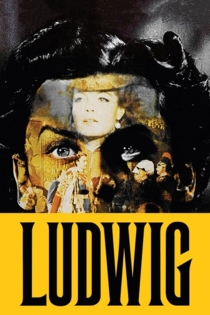
Ludwig
Luchino Visconti
Helmut Berger, Romy Schneider
Historical evocation of Ludwig, king of Bavaria, from his crowning in 1864 until his death in 1886, as a romantic hero. Fan of Richard Wagner, betrayed by him, in love with his cousin Elisabeth of Austria, abandoned by her, tormented by his homosexuality, he will little by little slip towards madness.
Ludwig