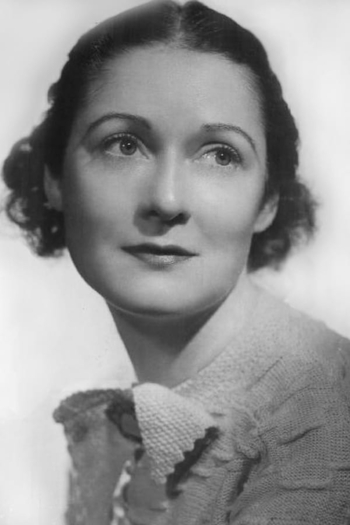
Phoebe Foster
1895 - 1975Phoebe Foster (born Angeline Egar; July 9, 1896 - June 1975) was an American theater and film actress.
Foster studied at the American Academy of Dramatic Arts. She began appearing on Broadway in 1914, starting with a production of Roi Cooper Megrue's Under Cover. Her subsequent Broadway appearances included The Cinderella Man (1916), Three's a Crowd (1919), Captain Applejack (1921), The Jazz Singer (1925), and Topaze (1930).
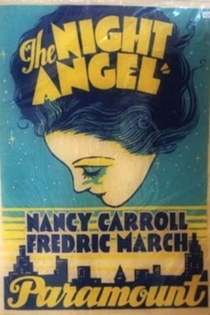
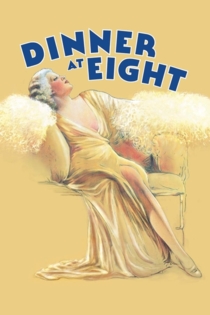
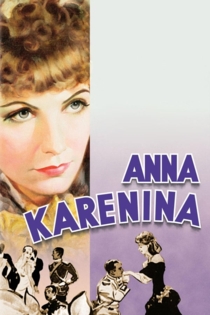
After appearing in a couple of short films, in 1931 she made her feature film debut in George Cukor's Tarnished Lady alongside Tallulah Bankhead. That same year she also appeared in Edmund Goulding's The Night Angel with Nancy Carroll and Fredric March. In 1933, she was in the comedies Our Betters and Dinner at Eight, both directed by Cukor. Two years later she appeared in the Tolstoy adaptation Anna Karenina with Greta Garbo. In 1935 she also returned to Broadway for the brief run of Living Dangerously. In 1936 she had her first stage appearance in London, starring in a production of Night of January 16th. Foster's last movie was The Gorgeous Hussy in 1936. Her final Broadway production was American Landscape (1938).
Personal life
Foster was born in 1896 as Angeline Egar (possibly Eager) in Center Harbor, New Hampshire. She was the daughter of Arthur and Emily Egar.
Foster married millionaire Harold LeRoy Whitney, heir to an ironworks fortune, on September 12, 1927. Whitney had divorced his previous wife just days before. The couple kept the marriage secret for several days before the press discovered it. They filed for divorce in 1943. Phoebe Foster died in 1975 in Boston, Massachusetts.
Dinner at Eight
George Cukor
Marie Dressler, John Barrymore
An ambitious New York socialite plans an extravagant dinner party as her businessman husband, Oliver, contends with financial woes, causing a lot of tension between the couple. Meanwhile, their high-society friends and associates, including the gruff Dan Packard and his sultry spouse, Kitty, contend with their own entanglements, leading to revelations at the much-anticipated dinner.
Dinner at Eight
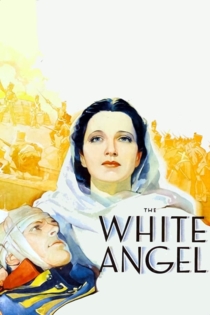
The White Angel
William Dieterle
Kay Francis, Ian Hunter
In mid-nineteenth century England the medical establishment does not recognize the value of skilled nurses, cleanliness, nutrition and kindness. Florence Nightingale's heroic measures slowly changes all of this.
The White Angel
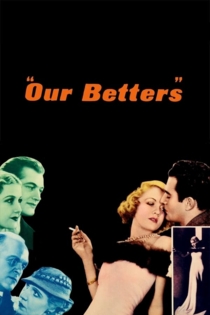
Our Betters
George Cukor
Constance Bennett, Violet Kemble Cooper
Soon after being wed, American heiress Lady Pearl Grayston realizes her husband has married her for her money and is keeping a mistress. The two maintain a loveless marriage, a trade-off Pearl accepts in order to gain admittance to her husband's aristocratic social circle. While Pearl pursues her own affair with gigolo Pepi D'Costa, her visiting sister, Bessie, arrives and is appalled when Pearl's arrangement is revealed.
Our Betters
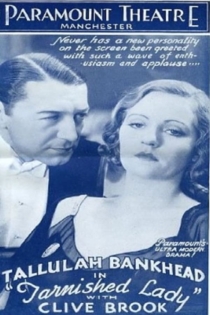
Tarnished Lady
George Cukor
Tallulah Bankhead, Clive Brook
Nancy Courtney, a once wealthy socialite, has had to struggle to maintain a facade of prosperity ever since her father's death. Although she loves writer DeWitt Taylor, who is indifferent to amassing a fortune, her mother urges her to marry stockbroker Norman Cravath instead. Nancy acquiesces to her mother's wishes but, despite the fact her new husband does everything he can to please her, she is miserable in her marriage.
Tarnished Lady
The Night Angel
Edmund Goulding
Nancy Carroll, Fredric March
In this crime drama, a Prague DA must close down a house of prostitution masquerading as a cafe. He sends the owner's daughter to a nurse's home until her mother is released. When the happy day comes, he goes to visit them, but is attacked by the doorman, who is in love with the daughter and jealous of the DA. The DA kills him in self-defense but is acquitted when the daughter delivers a highly emotional speech professing her love for him.
The Night Angel