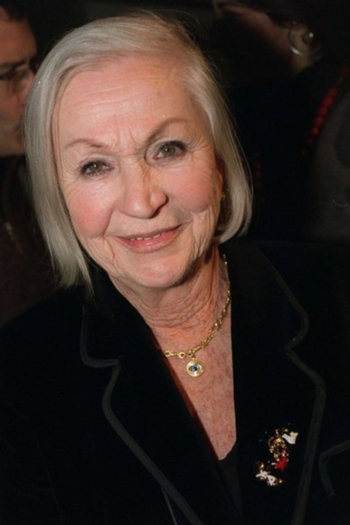
Ginette Garcin
1928 - 2010She lived in Audresselles, Pas-de-Calais. Ginette Garcin made her musical debut with Jacques Hélian and his orchestra in 1946. She then worked with Loulou Gasté and went on to appear in Strélesky's absurdist theatre revues in Rouen. Her portrayal of Charlot to the music of Deux petits chaussons was very well received. She collaborated with Colette Vudal (who later adopted the name Colette Monroy in Paris), Mona Monick and Robert Thomas, author of some successful detective plays.
Garcin was one of the first to perform and record the songs of Boby Lapointe and Jean Yanne in the 1960s. In the 1970s, she embarked on a career in film and theatre, with guidance from Audiard, Lelouch, Yanne, Boisset and Tacchella. She appeared in the television series Marc et Sophie. In 1990, she wrote the critically acclaimed Le clan des veuves in which she starred alongside Jackie Sardou for four years. In 1997, she had an acting and singing role in Le passe-muraille, a musical comedy by Marcel Aymé with Didier van Cauwelaert and Michel Legrand.
In her final decade, Ginette Garcin played a character in the television series Famille d'accueil as well as appearing in the films La Beuze and Les Dalton. A new version of Le clan des veuves was staged at the Bouffes-Parisiens theatre in 2006.
Also in her later years she appeared in Raphaël Mezrahi's play, Monique est demandée en caisse 12.
She died on 10 June 2010 at age 82 of breast cancer.
Source: Article "Ginette Garcin" from Wikipedia in English, licensed under CC-BY-SA 3.0.

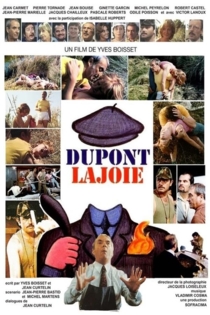
Dupont Lajoie
Yves Boisset
Jean Carmet, Pascale Roberts
As every summer, Georges Lajoie, his wife Ginette and grown-up son Léon go on holiday to Loulou's campsite. They join old friends, the Schumachers and the Colins. Brigitte Colin, the daughter, is quite a pretty young girl now. One day, Georges rapes and murders her. He hides the body near the barracks of the immigrant Arab workers. The racism of the campers will do the rest... A virulent lampoon against the average Frenchman's racism.
The Common Man
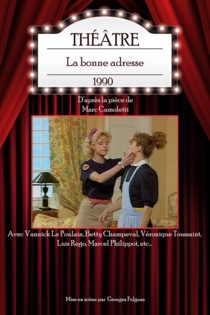
Le clan des veuves
Jean-Louis Lorenzi
Jackie Sardou, Ginette Garcin
The Widows' Clan is a play written by Ginette Garcin, premiered in 1989 at the Théâtre Municipal de Charenton and repeated in 1990 at the Théâtre Fontaine. It will be recorded for television and broadcast on Antenna 2 in 1992. Jacky and Marcelle, already widows for several years, console Rose whose husband has just died in the toilet: he has been flushed on the head. All three form the clan of widows and tell each other, in spicy secrets, their past couple life. Rose soon learns of the existence of Mireille, the mistress of her late husband, and of her two daughters Jeanne and Jeanine. All these little people obviously come to claim their share of inheritance. Rose goes from surprise to surprise, supported with humor by her two friends, until the final scene where the doorbell rings: a little boy (voiceover) brings back a pair of gloves found in the street, Rose asks her name , his name is Jacques Stelman, like her late husband!
Le Clan des Veuves

Bolero: Dance of Life
Claude Lelouch
Robert Hossein, Nicole Garcia
The film follows four families, with different nationalities (French, German, Russian and American) but with the same passion for music, from the 1930s to the 1960s. The various story lines cross each other time and again in different places and times, with their own theme scores that evolve as time passes. The main event in the film is the Second World War, which throws the stories of the four musical families together and mixes their fates. Although all characters are fictional, many of them are loosely based on historical musical icons (Édith Piaf, Josephine Baker, Herbert von Karajan, Glenn Miller, Rudolf Nureyev, etc.) The Boléro dance sequence at the end brings all the threads together.
Bolero: Dance of Life

Rouget le braconnier
Gilles Cousin
Jean-Michel Noirey, Olivia Brunaux
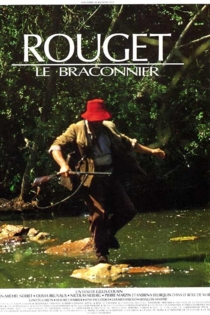
The adventurous and dangerous life of a nineteenth-century Anjou poacher hunted by the local justice system for several years. Betrayed by the woman who loved him, he is arrested and sentenced to deportation to Cayenne.
Rouget le braconnier
La Grâce
Pierre Tchernia
Michel Serrault, Rosy Varte
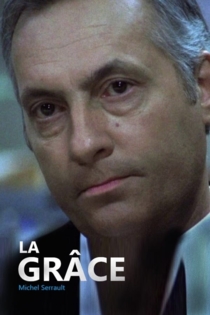
Duperrier, a model of piety, justice and charity, wakes up one day with a halo over his head, to the great despair of his wife who fears the gossip of the neighborhood. He's obliged to do everything possible to lose this gift from heaven.
La Grâce
Ne pleure pas
Jacques Ertaud
Sylvain Joubert, Xavier Labouze
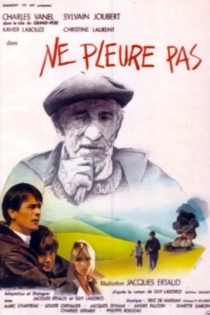
Marc Lafarge, 13, is idolized by his brother Thomas, 20, future veterinarian and amateur boxer. Thomas has a soul of justice. Thus, returning home with Marc after a fight, he hits a little thug who has just robbed an old lady.
Ne pleure pas
L'homme de ma vie
Jean-Charles Tacchella
Maria de Medeiros, Thierry Fortineau
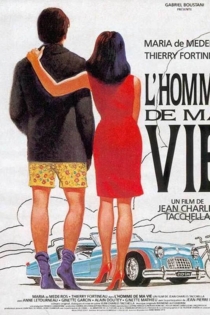
A delightfully classic French comedy of high sophistication and light hearted wit, that in the end suffers for it. This is immensely watchable simply for the presence of Maria De Medeiros, the central two of the film are captivating. What spoils it is the stereotypical and under developed second characters and an overly wistful outlook. But I defy any man watching this film not to fall madly for Aimee and everyone will cherish the scenes between Aimee and Maurice.
L'homme de ma vie
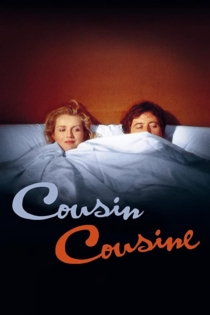
Cousin, Cousine
Jean-Charles Tacchella
Marie-Christine Barrault, Victor Lanoux
Two distant cousins meet at a wedding banquet for an elderly couple. Over time, a close friendship develops between them, but their spouses begin to think that they are more than just friends.
Cousin, Cousine

Tout le monde il est beau, tout le monde il est gentil
Jean Yanne
Michel Serrault, Jean Yanne
Selon "Radio plus près de Dieu", rien n'est conçu sans Dieu, surtout pas les shampoings, produits de beauté, la vente des disques... Un animateur dénonce cette escroquerie à l'antenne, ce qui lui vaut d'être licencié. Il réapparaîtra sur de nouvelles ondes avec "Radio plus près de la Vérité".
Everybody He Is Nice, Everybody He Is Beautiful

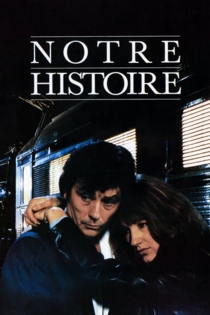
Notre histoire
Bertrand Blier
Alain Delon, Nathalie Baye
Robert Avranche, a middle-aged, alcoholic garage owner, is sitting on a train, reflecting on the emptiness of his life. An attractive young woman, Donatienne, suddenly enters the compartment and offers to make love to him. Robert accepts but, when the woman leaves the train afterwards, he decides to follow her...
Our Story
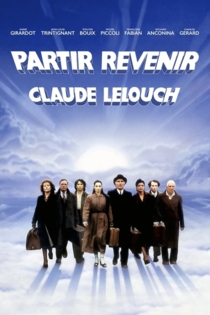
Partir, revenir
Claude Lelouch
Annie Girardot, Jean-Louis Trintignant
Salomé Lerner just finished writing an autobiography. She goes to a TV show called "Apostrophes", hosted by French TV showman Bernard Pivot. Pivot then imagines a film that could be created from her gripping story. A film entirely made of music because after seeing the young pianist Erik Berchot, Salomé believes seeing her long lost brother, who was a musician as well. A brother she had lost along with her parents in 1943. However, the Lerners did in fact escape the gestapo and might have based themselves in Paris...
Going and Coming Back
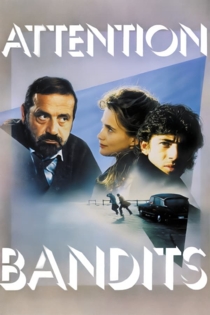
Attention bandits!
Claude Lelouch
Jean Yanne, Marie-Sophie L.
On the day Jean Gabin dies, a kidnaper who also takes a fortune in jewels heisted from Cartiers murders Simon Verini's wife. (Simon was fencing the jewels for a youthful gang who robbed Cartiers; he suspects them of the murder.) He's framed for the theft and spends ten years in prison, writing to his daughter, Marie-Sophie, who's 11 when he's sent away. Released, he reconnects to Marie-Sophie and to the young thieves, seeks revenge, and is quickly arrested again. She doesn't know what to make of her father, retreats to her Swiss fiancé, and is flummoxed when one of the young thieves falls for her. Is resolution possible when crime cuts across families and romance?
Bandits