
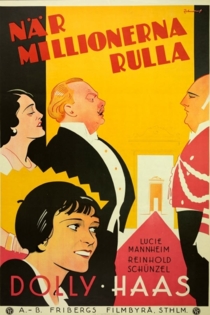
Lucie Mannheim
1899 - 1976Mannheim was born in Berlin–Köpenick where she studied drama and quickly became a popular figure appearing on stage in plays and musicals. Among other roles, she played Nora in Ibsen's A Doll's House, Marie in Büchner's Woyzeck, and Juliet in Shakespeare's Romeo and Juliet. She also began a film career in 1923, appearing in several silent and sound films including Atlantik (1929) – the first of many versions of the story of the ill-fated RMS Titanic. The composer Walter Goetze wrote his operetta Die göttliche Jette (1931) especially for Mannheim. However, as a Jew she was obliged to stop acting in 1933, when her contract at the State Theatre was cancelled. She promptly left Germany, first to Czechoslovakia, then to Britain. She appeared in several films there, notably as the doomed spy Annabella Smith in Alfred Hitchcock's 1935 version of The 39 Steps.
During World War II she appeared in several films, as well as broadcasting propaganda to Germany – including performing an anti-Hitler version of Lili Marleen in 1943. In 1941, she married the actor Marius Goring.
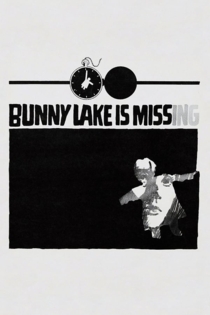
She returned to Germany in 1948 and resumed her career as an actress on stage and in film. In 1955 she joined the cast of the British television series The Adventures of the Scarlet Pimpernel as Countess La Valliere. She made her final English-language film appearance in the 1965 film Bunny Lake Is Missing. Her last appearance was in a 1970 TV movie. She died in Braunlage.
Description above from the Wikipedia article Lucie Mannheim, 1st Baron Tweedsmuir, licensed under CC-BY-SA,full list of contributors on Wikipedia.

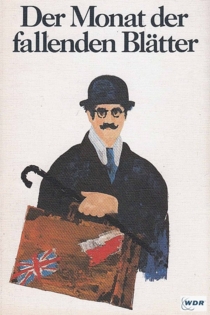
Der Monat der fallenden Blätter
Dietrich Haugk
Ernst Fritz Fürbringer, Heinz Klevenow
When British philosopher Harold Hilliard took off for Warsaw to lecture on the Dysteleological Surd, he had no idea that he would soon become embroiled in international espionage. During the trip he tried to open a suitcase he mistook for his own. When a fellow passenger, a Pole with stainless steel teeth, took umbrage, Hilliard put it down to bad manners, but when the same man saw him pick up the wrong coat in the plane, Hilliard realized that he was suspected of spying. The party at the airport to welcome Hilliard only convinced the Polish agent that the British Secret Service was now picking its men with extraordinary cleverness. Hilliard, whose works were little known in England, was warmed by unaccustomed praise but chilled by the apparent certainty of the counter espionage people that he was a British agent whose code name was Whale.
Der Monat der fallenden Blätter
The 39 Steps
Alfred Hitchcock
Robert Donat, Madeleine Carroll
Richard Hanney has a rude awakening when a glamorous female spy falls into his bed - with a knife in her back. Having a bit of trouble explaining it all to Scotland Yard, he heads for the hills of Scotland to try to clear his name by locating the spy ring known as The 39 Steps.
The 39 Steps


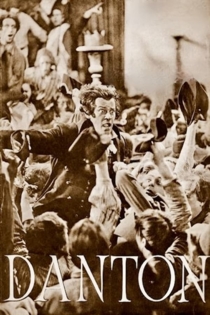
Danton
Hans Behrendt
Fritz Kortner, Lucie Mannheim
This pre-WW II German costume drama chronicles the French Revolution with a particular focus upon Danton, Robespierre, and Marat. It depicts the dramatic downfall and execution of Georges Danton in 1794 at the hands of Maximilien Robespierre. The film also presents an interesting, if not historically inaccurate, portrayal of Louis XVI.
Danton
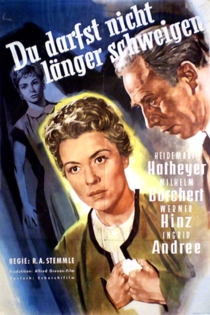
Du darfst nicht länger schweigen
Robert A. Stemmle
Heidemarie Hatheyer, Wilhelm Borchert
A Nordic fishermen's village surrounded by the raging sea. This is were fisherman Haldor (Wilhelm Borchert) is living. His marriage with the proud Salvör (Heidemarie Hatheyer) is going to be impend. While on the sea in a storm, he is being cast upon an island. There he falls in love with the farmer's girl Maria (Ingrid Andree). When Haldor learns, that Maria is pregnant, he takes her with him back home. Salvör who was still waiting, hates him for that and marries a rich merchant. Twenty years later Haldor's daughter Gunna and Salvör's son Ragnar, are falling in love with each other. And only now Haldor learns from Salvör that Ragnar is his son.
You Can No Longer Remain Silent
The Last Witness
Wolfgang Staudte
Martin Held, Hanns Lothar
Director Wolfgang Staudte who left East Germany in 1953 to make movies in West Germany, takes a few swipes at the West German judicial system in this fairly effective courtroom drama about the murder of a four-month-old baby. Police almost immediately arrest the mother Ingrid who is the mistress of the father, a rich business VIP married to another woman. His position and wealth keep him insulated from suspicion. A hot-shot lawyer has to overcome the unaccountably biased perceptions of the police, the judge, the prosecutor and almost everyone else in the judicial system. The defence lawyer, driven to an extreme, knows he has to find the real killer or his client will be convicted.
The Last Witness