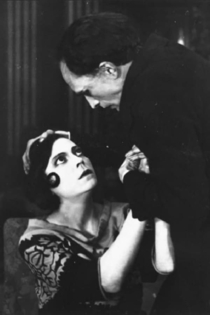
Hugo Döblin
1876 - 1960
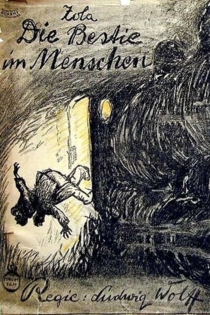
Die Bestie im Menschen
Ludwig Wolff
Ossip Runitsch, Maria Orska
Jacques Lantier, the "human beast" of the title, has a hereditary madness and has several times in his life wanted to murder women. At the beginning of the story he is an engine driver, in control of his engine "La Lison". His relationship with "La Lison" is almost sexual and provides some degree of control over his mania.
Die Bestie im Menschen

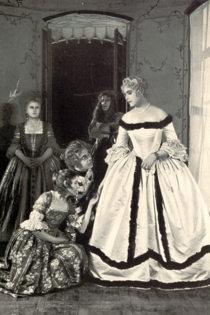
Ein Glas Wasser
Ludwig Berger
Mady Christians, Lucie Höflich
A Glass of Water (German: Ein Glas Wasser) is a 1923 German silent historical film directed by Ludwig Berger and starring Mady Christians, Lucie Höflich and Hans Brausewetter. It premiered at the UFA-Palast am Zoo on 1 February 1923. It was based on a play of the same title by Eugène Scribe, set in England during the reign of Queen Anne. The film was very well received both commercially and critically on its release. It is considered one of the milestones of Weimar cinema
A Glass of Water
Von morgens bis Mitternacht
Karlheinz Martin
Ernst Deutsch, Erna Morena
A cashier in a bank in a small German town is alerted to the power of money by the visit of a rich Italian lady. He embezzles 60,000 Marks and leaves for the capital city, where he attempts to find satisfaction in politics, sport, love and religion.
From Morn to Midnight

Matto regiert
Leopold Lindtberg
Heinrich Gretler, Heinz Woester
If any one man is responsible for the rejuvenation of the postwar Swiss film industry, that man was director Leopold Lindtberg. Matto Regiert (Madness Rules) was co-adapted for the screen by Lindtberg from a novel by Friedrich Glauser. Heinrich Gretler stars as Police Constable Studer, the hero of several of Glauser's most popular works. This time, Studer must solve the murder of the director of an insane asylum -- and it's not (surprise, surprise) the most likely suspect, manic-depressive patient Herbert Caplaun. For box-office purposes, Matto Regiert stresses a romantic subplot involving Caplaun and nurse Irma Wasem.
Madness Rules

Der Raub der Mona Lisa
Géza von Bolváry
Trude von Molo, Willi Forst
This German crime drama was based on a true story. Willy Forst stars as a poverty-stricken Italian glazier who falls in love with French hotel maid Rosa Valletti. Struck by the girl's resemblance to Leonardo Da Vinci's Mona Lisa, Forst manages to steal the painting from the Louvre in hopes of impressing his sweetheart. But when the girl proves to be a fickle sort, the crestfallen hero confesses his crime and is carted off to jail. Unwilling to admit that he'd been led astray by a woman, Forst claims that he stole the Mona Lisa to restore it to his native Italy, and as a result is hailed as a national hero! Raub der Mona Lisa was distributed in the U.S. by RKO Radio, under the title The Theft of the Mona Lisa.
The Theft of the Mona Lisa


Lucrezia Borgia
Richard Oswald
Conrad Veidt, Liane Haid
Rodrigo Borgia, Pope Alexander VI, has three adult children: Juan, who is virtuous and has a sweetheart who is a woman of the people, Lucrezia, who is virtuous and wants to marry Alfonso, and Cesare, who is wicked and lusts after Lucrezia, Juan's girlfriend, and probably others. Cesare has vowed to kill any suitor for Lucrezia's love, and he has three thugs to carry out his wishes. Bodies fall into the Tiber, into the Colosseum (with lions prowling), and onto the Vatican floors.
Lucrezia Borgia

Die Gezeichneten
Carl Theodor Dreyer
Polina Piekowskaja, Vladimir Gajdarov
Based on the novel 'Elsker hverandre' by Aage Madelung, the film follows various lives, one of which is Jewish girl Hanne-Liebe, as she grows up, and experiences the pains of living as a Jew in Russia, leading to a revolution.
Love One Another


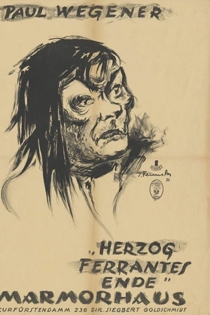
Ramper, der Tiermensch
Max Reichmann
Paul Wegener, Mary Johnson
Paul Wegener gives one of his most active performances here as Captain Ramper, a heroic aviator who makes a pioneering flight across the Arctic accompanied only by Ippling, his faithful mechanic (Kurt Gerron). Near the North Pole, their plane develops engine failure and crashes in the desolate wastes. Ippling dies straight off but Ramper finds a supply base containing food which has been left behind by a previous expedition. After fifteen years in the Arctic wastes, Ramper has considerably mutated.
The Strange Case of Captain Ramper