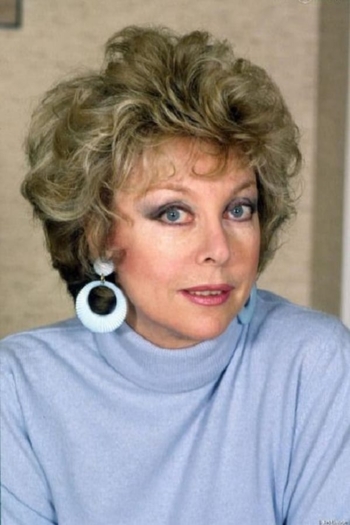
France Roche
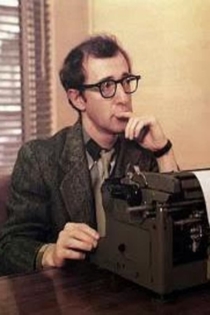
1921 - 2013She collaborated in particular with: Ciné Mondial (1941-1944), Cinévie and especially Cinémonde of which she was editor-in-chief, magazines devoted to cinema; Marie France then France-Soir, as head of the cinema page of Pierre Lazareff's daily newspaper. The newspaper then has a circulation of more than a million copies and can have three or four editions per day. She is the “Madame Cinema” of the most powerful French newspaper; the ORTF, as part of the broadcasts: Five columns on the front page, where she notably carries out an interview with Brigitte Bardot, Cinépanorama (programs on cinema, notably on the Cannes festival), Thirty years of silence (on the stars of silent cinema) and Headliner: long interviews with Pierre Brasseur, Madeleine Renaud (1966), Jean Marais (1968), Arletty, Annie Girardot (1969), Simone Signoret, Paul Meurisse (1970), Michel Piccoli (1971), Jeanne Moreau (1972)…; Antenna 2: called by Jacqueline Baudrier, she becomes deputy editor-in-chief and editorialist, head of the culture department. She is the specialist in cinema, entertainment and fashion on the television news (1969-1986) within the framework of which she notably presents live every day during the Cannes Film Festival a column on the films in competition. She also interviews Woody Allen in the show Woody Allen or the Funniest Anhedonist in the World (1979).
She then participated in the shows Sexy Folies created by Pascale Breugnot (1986) in which she advised viewers on the telephone then J'aime à la Folie devoted to the Avignon Festival (1987-88): Canal Jimmy, where, at the request of Michel Thoulouze and Pierre Lescure she hosts T'as pas une idées, a trans-generational show in which a guest, born in the 1950s to 70s, is questioned by young people from the 1990s (1991-2001); CinéCinéma, where she presents the show Ciné-ciné court dedicated to short films; France Inter where she is a columnist for Pierre-Yves Guillen in the show Piment Rose.
France Roche is the author of several film scripts, notably with Michel Audiard, whom she discovered and starred in around fifteen films between 1950 and 1958.
She was a member of the jury at the Berlin Film Festival in 1961.
France Roche's career presents an atypical profile. Familiar with the general public until around 1965, she then took on executive functions more in the background, with less visibility, before returning to the screens from 1986. Such a long eclipse, although only apparent, and her return, have at the time created astonishment.
She was the wife of François Chalais then of Gilbert de Goldschmidt, with whom she has a son: Frédéric, born in 1959.
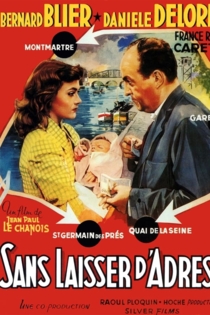
Zoé
Charles Brabant
Barbara Laage, Michel Auclair
Barbara Laage essays the title role in Zoe. Our heroine's adventures begin when she catches the eye of a big-city playboy named Arthur (Michel Auclair), who is attracted not only to Zoe's beauty, but by her insistence upon telling nothing but the whole truth. This trait causes no end of comic complications when Zoe moves into the palatial home of Arthur's family. The limit comes when Zoe botches a big business deal formulated by Arthur's not-altogether-honest father (Louis Seigner). Zoe is based on a stage farce by Jean Marsan.
Zoé
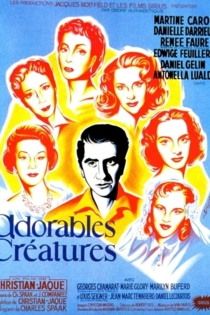
Adorables créatures
Christian-Jaque
Daniel Gélin, Antonella Lualdi
Andre Noblet, a 21-year-old French artist falls madly in love with Christine, the mother of two children. He tells Chistine he will tell all to her husband and demand her freedom. Christine learns that her husband has been carrying on a romance of his own and they have a meeting.
Adorable Creatures
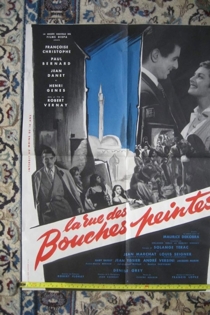
La rue des bouches peintes
Robert Vernay
Paul Bernard, Françoise Christophe
An English governor in India, deceived by his wife, proposes to him either to accuse the lover of embezzlement, or to condemn her to end her days as a prostitute in the rue des Bouches Peintes. She chooses the second solution...
La rue des bouches peintes
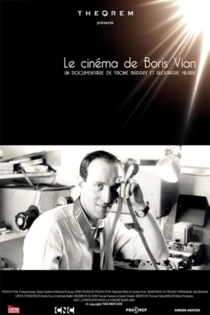
Le cinéma de Boris Vian
Yacine Badday, Alexandre Hilaire
Boris Vian, Nicole Bertold
On June 23, 1959, Boris Vian died of a heart attack while watching the film "I Spit Οn Your Graves", a frivolous adaptation of his novel of the same name, which he released under the pseudonym Vernon Sullivan. Taking as a starting point this fateful date for Vian's relationship with cinema, the documentary looks back at his cinematic experiences, his appearances in several films, his friendship with director Pierre Cast and his many unrealized screenplays. From the post-war period to the dawn of the 1960s, from the cellars of Saint-Germain-des-Prés to his apartment in Place Blanche, it is about the portrait of a diverse author who loved cinema with passion.
Le cinéma de Boris Vian