Anatoli Boukreev
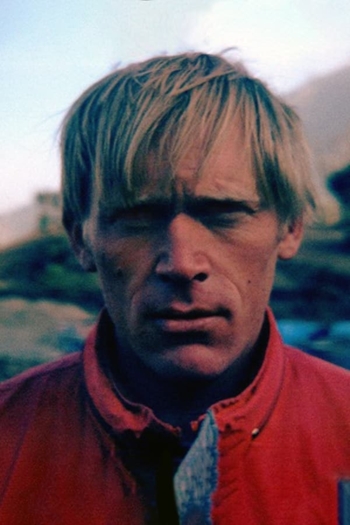
1958 - 1997Having climbed ten of the fourteen peaks over 8,000 meters on the planet, including seven without artificial oxygen supply, he is considered one of the greatest high-altitude mountaineers of his time. He became famous for his role in the 1996 tragedy on Everest. Boukreïev was born in January 1958 in Korkino, in the Russian Urals. After finishing high school, he entered the University of Chelyabinsk where he majored in physics and graduated in science in 1979. In 1989, he had his first big success in the Himalayas when he was part of a Soviet mountaineering expedition climbing Kangchenjunga, the third highest mountain in the world. Bukreïev spent a large part of his life in Kazakhstan, from which he obtained citizenship after the collapse of the Soviet Union.
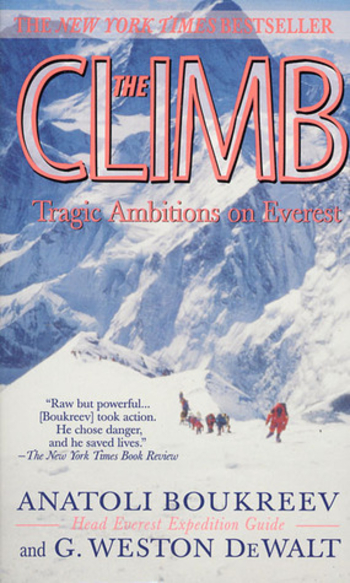
In May 1996, Bukreïev was employed by the company Mountain Madness to guide a commercial expedition led by Scott Fischer and which was to bring eight people to the summit of Everest. During the descent, the team is surprised by a violent snowstorm. Journalist Jon Krakauer, who was part of another team present on Everest during the tragedy (Adventure Consultants founded by Rob Hall), reports that Bukreïev had climbed to the top without artificial oxygen supply. According to Krakauer, this attitude prevented him from fully playing his role as a guide to the maximum of his abilities, a criticism echoed by some of his fellow guides. He was also criticized for descending too quickly from the summit.
During the storm, the Kazakh guide was one of the main architects of the rescue of mountaineers in perdition. Boukreyev ascended twice to the summit, in the midst of a storm and at the risk of his life. He managed to save three climbers from the expedition (Tim Madsen, Charlotte Fox and Sandy Hill Pittman who had gotten lost during their descent to Camp IV (7,906 m) located at the South Col. These, blinded and disoriented by storm and nightfall, had headed for the eastern part of the South Col and the face of Kangshung, while the camp was located in its western part.He also embarked on a desperate attempt to rescue Fischer , stuck further up the mountain, but when he arrived, he was already dead. Baltasar Kormákur's 2015 film "Everest" is inspired by this heroic rescue.
On May 17, after two days of rest at base camp, he climbed Lhotse via the South Col.
He died on December 25, 1997, swept away by an avalanche during an attempted winter ascent of Annapurna by the south face in the company of Simone Moro and Dimitri Sobolev. On December 6, 1997, the American Alpine Club presented him with the David A. Sowles Memorial Award for his heroism in rescuing mountaineers lost in the storm.
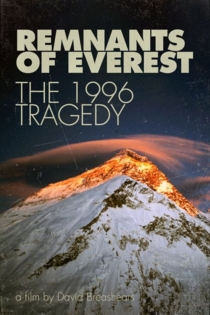
Remnants of Everest: The 1996 Tragedy
David Breashears
Neal Beidleman, David Breashears
As darkness fell on May 10, 1996, a fast-moving storm of unimaginable ferocity trapped three climbing teams on the slopes of Mount Everest. The climbers, exhausted from their ascent to the summit, were soon lost in the dark, in a ferocious blizzard, far from the safety of High Camp at 26,000 feet. This film tells the story of the five climbers who perished in this storm, marking the worst climbing tragedy in the history of Mount Everest. But most remarkably, it's the story of eleven climbers caught in the storm, and eyewitness accounts of their astonishing survival in the world's most unforgiving environment.
Remnants of Everest: The 1996 Tragedy
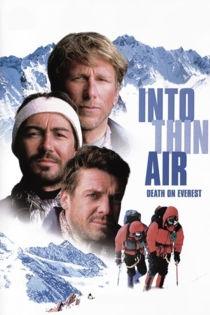
Into Thin Air: Death on Everest
Robert Markowitz
Peter Horton, Nathaniel Parker
An adaptation of Jon Krakauer's best selling book, "Into Thin Air: A Personal Account of the Mt. Everest Disaster". This movie attempts to re-create the disastrous events that took place during the Mount Everest climb on May 10, 1996. It also follows Jon Krakauer throughout the movie, and portrays what he was going through while climbing this mountain.
Into Thin Air: Death on Everest
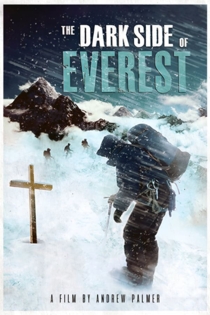
The Dark Side of Everest
Andrew Palmer
Pete Athans, Neal Beidleman
May 25, 1996 - Bruce Herrod, a South African mountaineer reached the summit of Everest at 5 p.m. On the radio, we urge him to come down as soon as possible because the descent is dangerous in the middle of the night. A few hours later, no news from him. From this South African expedition which turned into a fiasco and another expedition carried out in parallel, the testimonies of the members of these expeditions show to what extent the thirst for climbing to the top of certain mountaineers, combined with the lack of oxygen , can alter the lucidity of climbers to the point of changing their relationship to death and thus lead them to neglect other expedition members in order to ensure their victory or save their own life.
The Dark Side of Everest
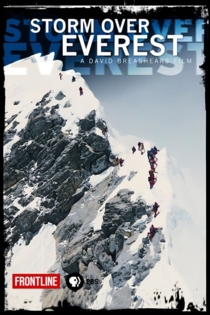
Storm Over Everest
David Breashears
David Breashears, Makalu Gau
As darkness fell on May 10, 1996, a fast moving storm of unimaginable ferocity trapped three climbing teams high on the slopes of Mount Everest. The climbers, exhausted from their summit climb, were soon lost in darkness, in a fierce blizzard, far from the safety of High Camp at 26,000 feet. World-renowned climber and filmmaker David Breashears, who aided the rescue efforts back in 1996, now returns to Everest to tell the fuller story of what really happened on that legendary climb. Through remarkably intimate interviews with the climbers and Sherpas many who have never spoken before on American television Breashears sheds new light on the worst climbing tragedy in Mount Everest s history.
Storm Over Everest