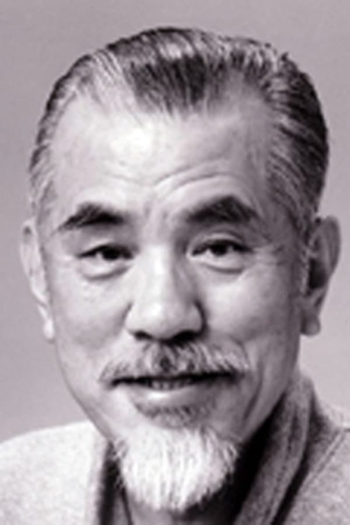
Masao Imafuku
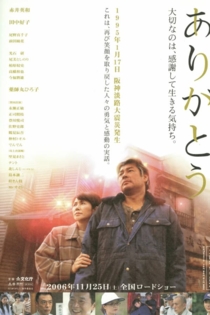
1921 - 2015ありがとう
Kunitoshi Manda
Hidekazu Akai, Masao Imafuku
In the early morning of January 17, 1995, the Great Hanshin-Awaji Earthquake struck, and Tadao Furuichi (Hidekazu Akai), who was running a camera store in Kobe City, lost his friends, his house, and his property. Tadao is busy volunteering for the reconstruction of the town, and one day he comes across his own golf bag that survived the earthquake. Feeling a miracle, Tadao decides to challenge the professional golf test before he turns 60.
Arigatou
素浪人罷り通る
Kazuo Ikehiro
Toshirō Mifune, Kahori Takeda
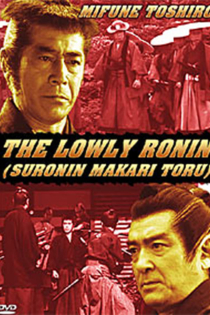
Reprising his role from the popular TV series "Koya no Suronin" (The Lowly Ronin), Mifune Toshiro stars in this full-length, stand-alone made for TV movie. The wandering ronin is reminiscent of his most famous role as the samurai without a name in Kurosawa's "Yojimbo" and "Sanjuro". He travels about Japan, and while he may seek happiness, violence and tragedy always cross his path. This time, he reluctantly agrees when a girl hires him to kill a local offical who has unfairly taxed her villagers. But he soon discoves that not all is at it appears when he finds a direct link to his past.
Lowly Ronin
修羅
Toshio Matsumoto
Katsuo Nakamura, Juro Kara
Gengobe Satsuma, an exiled samurai cast out as an Asano clan retainer is given a second chance to join his brothers in arms to become the 48th Ronin against the Shogunate. His faithful servant gathers the 100 ryo required for his acceptance. Gengobe is also in love with a greedy geisha named Koman. About to be sold to another man, Gengobe learns that for him to keep her, her debt is exactly 100 ryo.
Demons

Japan's Longest Day
Kihachi Okamoto
Seiji Miyaguchi, Rokkō Toura
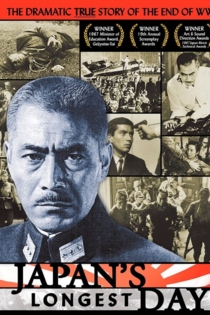
Following the detonation of the atomic bombs on Hiroshima and Nagasaki, the Japanese military and the government clash over the demand from the Allies for unconditional surrender. Minister of the Army Anami leads the military officers who propose to fight on, even to the death of every Japanese citizen. Emperor Hirohito, however, joins with his ministers in asking the unthinkable, the peaceful surrender of Japan. When the military plots a coup to overthrow the Emperor's civilian government, Anami must face the choice between his desires and loyalty to his Emperor.
Japan's Longest Day
Kill!
Kihachi Okamoto
Tatsuya Nakadai, Etsushi Takahashi
A pair of down-on-their-luck swordsmen arrive in a dusty, windblown town, where they become involved in a local clan dispute. One, previously a farmer, longs to become a noble samurai. The other, a former samurai haunted by his past, prefers living anonymously with gangsters. But when both men discover the wrongdoings of the nefarious clan leader, they side with a band of rebels who are under siege at a remote mountain cabin.
Kill!



同胞
Yoji Yamada
Chieko Baisho, Akira Terao
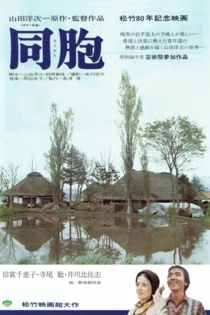
This appears to be a labor of love. Its about a village which is given the opportunity to put on a musical. They would have to pay the overhead and, being that they are farmers and always busy and not rich, question the wisdom and feasibility of such an idea. A spokesperson for the acting troupe Ms. Kono lays out the whole thing and they must decide. You get little slices of rural life in Japan far, at least in sentiment, from Tokyo. The best thing about this film is that it has heart. The acting is good, but it is really about the simple storyline of outing on a show. Films rarely get made with such simplistic plots these days. Enjoy this little slice of what city people call “the simple life”.
The Village
Wuthering Heights
Yoshishige Yoshida
Yūko Tanaka, Rentaro Mikuni
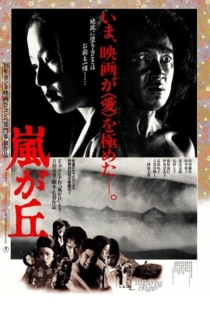
Young Kinu Yamabe is drawn to low-born Onimaru, who is vital and charismatic, but viewed by his father as a demon. After her first period, Kinu suffers the fate of any women born near the Sacred Mountain: she must leave the Mountain and serve as a priestess.
Wuthering Heights
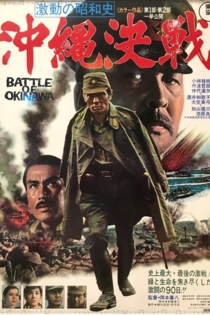
The Battle of Okinawa
Kihachi Okamoto
Keiju Kobayashi, Yûzô Kayama
The Americans are swiftly closing on Okinawa, an island just south of the Japanese mainland. The Imperial command sends top generals and several army divisions to defend it at all costs. The mission quickly degenerates as vital resources and troops are diverted to other islands. After a civilian evacuation ends in tragedy most of non-combatants are forced to remain on the island. Many convert to soldier status. Tokyo sends mixed messages that squander time and resources, as when they order the defenders to build an airstrip for aircraft that never come. The truth soon becomes obvious: the high command decides that the island cannot be held and effectively abandons the Okinawan defenders. When the Americans land many troops are deployed in the wrong places. As the slaughter mounts, a suicidal attitude takes hold. Okinawa becomes a death trap, for civilian volunteers and non-combatants as well.
The Battle of Okinawa