Heinz Emigholz
1948 (78 лет)

Schindler's Houses
Heinz Emigholz
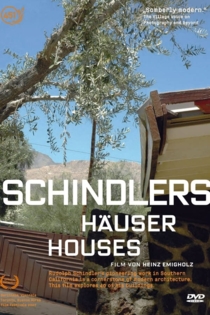
Both a beguiling meditation on the aesthetic of a city and a loving tribute to a great architect, Heinz Emigholz's documentary examines urban Los Angeles through the houses of Austrian-American architect Rudolph Schindler. Eschewing the documentary conventions of voice-over narration and archival photos, Emigholz mixes artfully composed images of more than 40 Schindler creations with an ambient soundscape to produce a singular viewing experience.
Schindler's Houses
Stalingrad
Joseph Vilsmaier
Dominique Horwitz, Thomas Kretschmann
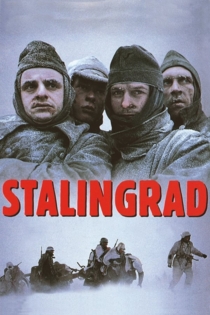
"Stalingrad" follows the progress of a German Platoon through the brutal fighting of the Battle of Stalingrad. After having half their number wiped out and after being placed under the command of a sadistic Captain, the Lieutenant of the platoon leads his men to desert. The men of the platoon attempt to escape from the city which is now surrounded by the Soviet Army.
Stalingrad
Sense of Architecture
Heinz Emigholz
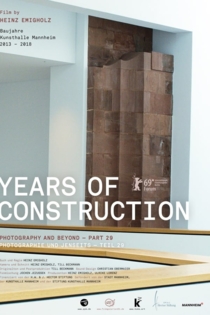
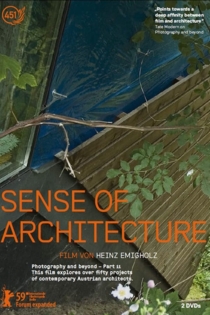
A passage through modern civilised life by way of 42 architectural projects in Austria and elsewhere. From a church belfry to a kindergarten, pharmacy, housing project etc. and finally to a crematorium and adjoining columbarium. A minimalist twentieth-century epic.
Sense of Architecture
Brother of Sleep
Joseph Vilsmaier
André Eisermann, Dana Vávrová
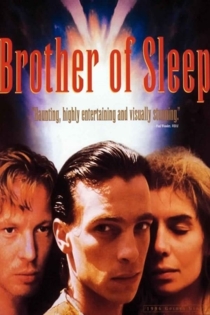
In the beginning of the 19th century, Johannes Elias Alder is born in a small village in the Austrian mountains. While growing up he is considered strange by the other villagers and discovers his love of music, especially rebuilding and playing the organ at the village church. After experiencing an "acoustic wonder", his eye color changes and he can hear even the most subtle sounds.
Brother of Sleep
Streetscapes [Dialogue]
Heinz Emigholz
John Erdman, Jonathan Perel
A film director confides in his interlocutor. He talks about the working process, about creative blocks, about artistic crises and expressive forces. At some point, the idea takes hold that this conversation could be turned into a film. And this is the very film we’re watching the two of them in.
Streetscapes [Dialogue]
![Streetscapes [Dialogue]](https://api.mamonto.com/media/cache/resolve/w210_hA/movies/6444/8486/cf6a4dc2982c_666408e326f0c.jpg)
Goff in der Wüste
Heinz Emigholz
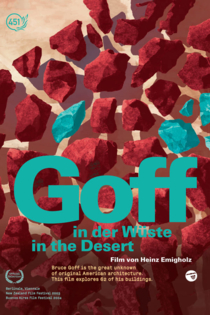
In this creative documentary, filmmaker Heinz Emigholz presents a series of filmed photographs of the work of the exceptionally inventive American architect Bruce Goff (1904-1982), who was apprenticed at age 12 but never formally educated as an architect. His work, mostly churches and private homes, displays a unique style that sets it apart from most 20th century architecture. The Episcopal Church in Tulsa built in the 1920s is a towering Art Deco icon, while the Hopewell Baptist Church in Edmond resembles a strange futuristic concrete teepee challenging the landscape. Bruce Goff is the great unknown of an original American form of architecture. Through his photo-driven style, Emigholz brilliantly exposes details of Goff's structures that might otherwise be missed, making these fascinating artifacts even more intriguing.
Goff in the Desert
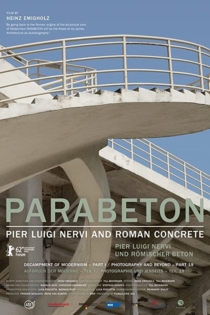
Parabeton: Pier Luigi Nervi und Römischer Beton
Heinz Emigholz
The third autobiography in the series deals with modern architecture. For the grand finale, he covers a broad historical spectrum: Parabeton tells of the great Roman concrete buildings from the start of the Common Era and compares them with Pier Luigi Nervi’s work, the Italian master of concrete construction. As concrete can be made into many different shapes, the buildings and the domes, slopes and spiral staircases they contain have an innovative, seminal quality. Those familiar with Emigholz's work will note that the skewed camera angles used in the past are replaced by straight-on views. Moreover, the ancient constructions seem more dynamic than those of the last century. Almost devoid of people, the images we know from his preceding films make the ruins from the 1930s to the 70s, the familiar cement constructions of daily life with their play of light and shadow or even the Pope’s Audience Hall appear more ghostly than the famous sights of the ancient world.
Parabeton: Pier Luigi Nervi and Roman Concrete
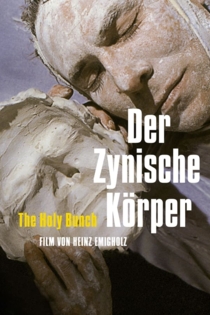
Der Zynische Körper
Heinz Emigholz
Klaus Behnken, Bernd Broaderup
After Roy's demise, five friends try to reconstruct his life by reading through the late editor's notebooks - only to face some very personal demons. The Holy Bunch is a modernist melodrama: beyond-Antonioni in its images, decisively Dreyerian in its spirituality. One of German cinema's few modern (or Modernist) masterpieces.
The Holy Bunch
Die Basis des Make-Up
Heinz Emigholz
Belgium, 9th october 1979. A cook drills a hole in the door to the "camera obscura" (lat. dark room) of his boss, a persian-american carpet dealer, who lives together with two women and a narcistic drunkard in a dark carpet-cave. All the characters walk a fine line between professional and private life, between dependence and exercise of power trying to save his/her love. Blatant voyeurism rules. The characters mutually spike their feelings whenever possible driving wedges of love into one another's flesh. Masochistoic institution grows out of romance, which portrayal degenerates into a comedy.
Die Basis des Make-Up