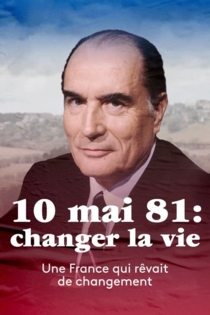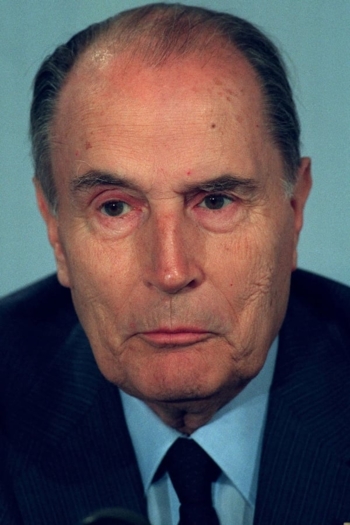
François Mitterrand
1916 - 1996Reflecting family influences, François Mitterrand started political life on the Catholic nationalist right. He served under the Vichy Regime during its earlier years. Subsequently he joined the Resistance, moved to the left, and held ministerial office several times under the Fourth Republic. Mitterand opposed Charles de Gaulle's establishment of the Fifth Republic. Although at times a politically isolated figure, he outmanoeuvered rivals to become the left's standard bearer at every presidential election from 1965–88, with the exception of 1969. He was elected president at the 1981 presidential election. He was re-elected in 1988 and remained in office until 1995.
François Mitterrand invited the Communist Party into his first government, which was a controversial decision at the time. In the event, the Communists were boxed in as junior partners and, rather than taking advantage, saw their support erode. They left the cabinet in 1984. Early in his first term, he followed a radical left-wing economic agenda, including nationalisation of key firms, but after two years, with the economy in crisis, he reversed course. He pushed a socially liberal agenda with reforms such as the abolition of the death penalty, the 39-hour work week, and the end of a government monopoly in radio and television broadcasting. His foreign and defense policies built on those of his Gaullist predecessors. His partnership with German Chancellor Helmut Kohl advanced European integration via the Maastricht Treaty, but he reluctantly accepted German reunification. During his time in office, he was a strong promoter of culture and implemented a range of costly "Grands Projets". He is the only French President to ever have named a female Prime Minister, Édith Cresson, in 1991. François Mitterrand was twice forced by the loss of a parliamentary majority into "cohabitation governments" with conservative cabinets led, respectively, by Jacques Chirac (1986–1988), and Édouard Balladur (1993–1995). Less than eight months after leaving office, he died from the prostate cancer he had successfully concealed for most of his presidency.
Beyond making the French left electable, François Mitterrand presided over the rise of the Socialist Party to dominance of the left, and the decline of the once-mighty Communist Party (as a share of the popular vote in the first presidential round, the Communists shrank from a peak of 21.27% in 1969 to 8.66% in 1995, at the end of François Mitterrand's second term). ...
Source: Article "François Mitterrand" from Wikipedia in english, licensed under CC-BY-SA 3.0.
De Gaulle, le dernier roi de France
Patrick Rotman
Samuel Labarthe, Charles de Gaulle
Charles de Gaulle, the first president (1958-1969) of the Vth Republic, France’s current system of government, left his mark on the country . He was statesman of action and has been compared to a monarch. This film depicts the general’s personality through the great events of his presidential term, at a time when the world was undergoing considerable changes.
De Gaulle, the Last King of France

Laboratory Greece
Jacopo Brogi
Winston Churchill, Barack Obama
A journey through Greece and Europe’s past and recent history: from the Second World War to the current crisis. It is a historical documentary, a look into many stories. «If Democracy can be destroyed in Greece, it can be destroyed throughout Europe» Paul Craig Roberts
Laboratory Greece
Donos de Portugal
Jorge Costa
António Guterres, António de Oliveira Salazar
Owners of Portugal is a documentary about one hundred years of economic power. The film portrays the State protection to families that dominated the country's economy, their strategies for power and wealth accumulation. Mello, Champalimaud, Espírito Santo - big families intersect by marriage and integrate by finance. Threatened by the end of the dictatorship, their power is restored under democracy, through privatization and promiscuity with politics. New economic groups - Amorim, Sonae, Jerónimo Martins - grow on the same basis. As the crisis unravels the limits of Portuguese economic development model, this film presents the actors and the main choices that brought us here.
Owners of Portugal
The Incredible Mr. Piccoli
Yves Jeuland
Michel Piccoli, Claude Sautet
A captivating portrait of French actor Michel Piccoli, who has worked with the greatest filmmakers of his time and has built a dazzling career of remarkable merit and success, focusing on his work during the 1970s and his professional relationship with Claude Sautet, Romy Schneider, Marco Ferreri and Luis Buñuel.
The Incredible Mr. Piccoli
Mr & Mme Adelman
Nicolas Bedos
Nicolas Bedos, Doria Tillier
How did Sarah and Victor get along for more than 45 years? Who was this enigmatic woman living in the shadow of her husband? Love, ambition, betrayals and secrets feed the story of this extraordinary couple, as they experience both the large and small moments of the last century's history.
Mr & Mme Adelman

Magician: The Astonishing Life and Work of Orson Welles
Chuck Workman
Simon Callow, Christopher Welles
The extraordinary life of Orson Welles (1915-85), an enigma of Hollywood, an irreducible independent creator: a musical prodigy, an excellent painter, a master of theater and radio, a modern Shakespeare, a magician who was always searching for a new trick to surprise his audience, a romantic and legendary figure who lived only for cinema.
Magician: The Astonishing Life and Work of Orson Welles
Les vendredis d'Apostrophes
Pierre Assouline
Bernard Pivot, Pierre Assouline
40 years of "Apostrophes". Hours and historical meetings, Pierre Assouline has composed an anthology of the best extracts presented in the form of a primer, which he had commented on by a surprised Bernard Pivot.
Les vendredis d'Apostrophes
1958, ceux qui ont dit non
Philippe Saada
Philippe Saada, Pierre Pflimlin
On October 4, 2018, France celebrated the 60th anniversary of the Fifth Republic. It is a republic born in the throes of the Algerian War and one which—from the day it was founded by General de Gaulle until the presidency of a very Jupiterian Emmanuel Macron—has been assailed as a “Republican monarchy” by partisans of a more assertive parliamentarian state. By revisiting the struggle of those who dared oppose the new regime — only to suffer a crushing defeat on September 28, 1958, when they were barely able to garner 20% of the vote against the constitutional text — this film shines a powerful new light on the origins of the Fifth Republic and its consequences for the next 60 years. It is a constitutional debate that planted the seeds for a complete upheaval of the French political landscape, on the left in particular, and set the country in motion toward what would be called the Union of the Left.
1958: Those Who Said No

L'Amour fou
Pierre Thoretton
Pierre Bergé, Yves Saint-Laurent
This documentary examines the life and work of the late fashion designer Yves Saint-Laurent, recounting how a frail prodigy prone to bouts of depression became an icon of the fashion world. Initially appointed head of the House of Dior in 1957 before growing into a globally recognized designer in his own right, Saint-Laurent overcomes his struggles with substance abuse, accumulating a large art collection alongside his lifelong personal and professional partner, Pierre Bergé.
L'Amour Fou

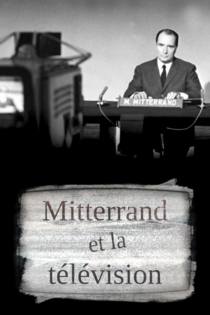
Mitterrand et la télé
Serge Moati
Serge Moati, François Mitterrand
May 10th, 1981. François Mitterrand is elected President of the Republic. The “soviet tanks” supposedly coming upon the Champs-Élysées dressed in red, feared by some, did not march. Serge Moati takes a personal look at this episode, focusing on the relationship the president had with television, that he witnessed and played a role in.
Mitterrand et la télé
10 mai 1981 : Changer la vie ?
Stéphane Benhamou
Anna Mouglalis, Ségolène Royal
Fourty years ago, in May 1981, with François Mitterrand's election, some people were letting themselves dream about a better life while others were predicting the coming of soviet tanks upon the Champs-Élysées. If we gladly remember the turning point of austerity in 83, there were also the wage rises, the fifth week of paid leave, the abolition of death penalty, the decriminalisation of homosexuality, or the advent of independent radio stations. Rare archives and accounts by those who were at the heart of this story give an overview of it and shed light on lesser-known aspects.
10 mai 1981 : Changer la vie ?